Why democracy has failed is not a question I planned to write about. It started with an argument online over a dead poet’s letter, and it ended with me doubting something I was raised to treat as untouchable. I want to walk you through how I got there, because the story says a lot about where many of us are today.
It Started With a Letter From 1934
A post went viral in Pakistan claiming that Allama Iqbal never dreamed of Pakistan. The proof was a letter he wrote on March 4, 1934 to Edward John Thompson, a British scholar at Oxford. People used it to say our Pakistan Studies books had lied to us since childhood.
The letter is real. I checked. But a real letter with no context can mislead as badly as a fake one.
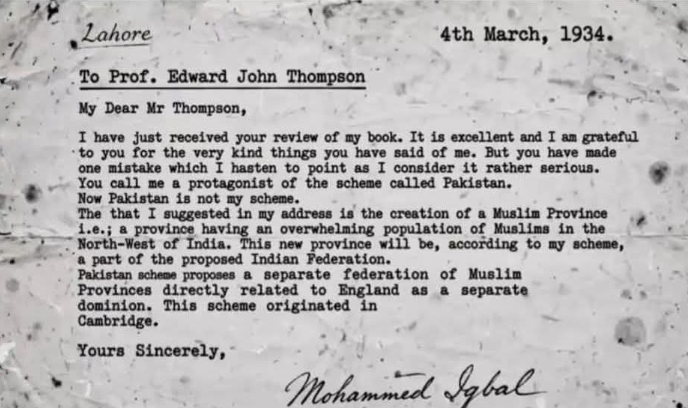
In 1933, a Cambridge student named Chaudhry Rehmat Ali published a pamphlet called Now or Never. It coined the name Pakistan and proposed a Muslim country completely separate from India. Iqbal wrote to Thompson to say that scheme was not his. His own idea, laid out in his 1930 Allahabad Address, was a Muslim state in the North West that would sit inside an Indian federation.
That was 1934. Then history kept moving.
What Iqbal Wrote to Jinnah Three Years Later
On June 21, 1937, Iqbal wrote to Muhammad Ali Jinnah. By then he had given up on the federal arrangement under the Government of India Act of 1935. He argued that a separate federation of Muslim provinces in the North West and Bengal was the only way to a peaceful India. He also worried about the poverty of ordinary Muslims and told the Muslim League to speak to the masses, not just to the upper class.
Iqbal died on April 21, 1938. The Lahore Resolution, later called the Pakistan Resolution, was passed on March 23, 1940 at Minto Park in Lahore with Jinnah in the chair. So Iqbal was not at that session, and he never signed it. But Jinnah himself wrote in the foreword to Iqbal’s published letters that Iqbal’s views were substantially in line with his own.
Put the dates in order and the picture is clear. The thinking of 1930 grew into the position of 1937, and that position led to 1940. A single letter from 1934 is one frame of a long film.
The Argument Over One Word
I replied to the post politely. The person who wrote it was a consultant doctor with a big following, so I wrote something like this. Doctor Sahiba, you are an educated woman, why spread half truths? Iqbal’s 1937 letters to Jinnah are public, please read them.
Then another man joined in. He said the dream people talk about was not the dream Iqbal had, and somehow he brought Dr. Abdul Kalam into it. Nothing he said connected to the topic. I explained that “dream” here is a metaphor for a vision, the same way Martin Luther King Jr. used it in 1963. Nobody thinks King literally fell asleep and saw the Civil Rights Act. Kalam himself is famous for saying a real dream is the thing that does not let you sleep, which supports my point more than his.
I got tired. I wrote that he was right and I was wrong, said salaam, and left.
And honestly, the whole thing felt absurd. You are sitting in a free, sovereign country. Partition killed somewhere between one and two million people and uprooted many more, and those people paid for the ground you stand on. Does it matter whether Iqbal “dreamed” it in the exact way a pedant wants? We are fighting over a word while the house is on fire.
That is the moment I started thinking about the bigger problem.
Social Media Gave Everyone a Microphone
I said something to a friend that I will repeat here, though it sounds harsh. The worst thing social media did was give a voice to people who have never earned one. I believe in equal human dignity and equal human rights. But a well-read scholar and a person who reacts to headlines are not the same in how much they understand, and the platform treats them as equals.
The irony is that the doctor in my story was highly educated. A degree in medicine does not make you a historian or a careful thinker. She grabbed a viral half-truth because it was exciting, and her title gave it extra weight. That taught me something I had to be honest about. The problem is not only the uneducated. It is also the lazy, the loud, and the people who skip the reading.
Psychology has a name for part of this, the Dunning-Kruger effect. People with little knowledge of a subject often feel the most certain about it, while real experts tend to hedge. Add an algorithm that rewards outrage and you get the situation we live in.
Is “One Person, One Vote” Actually Fair?
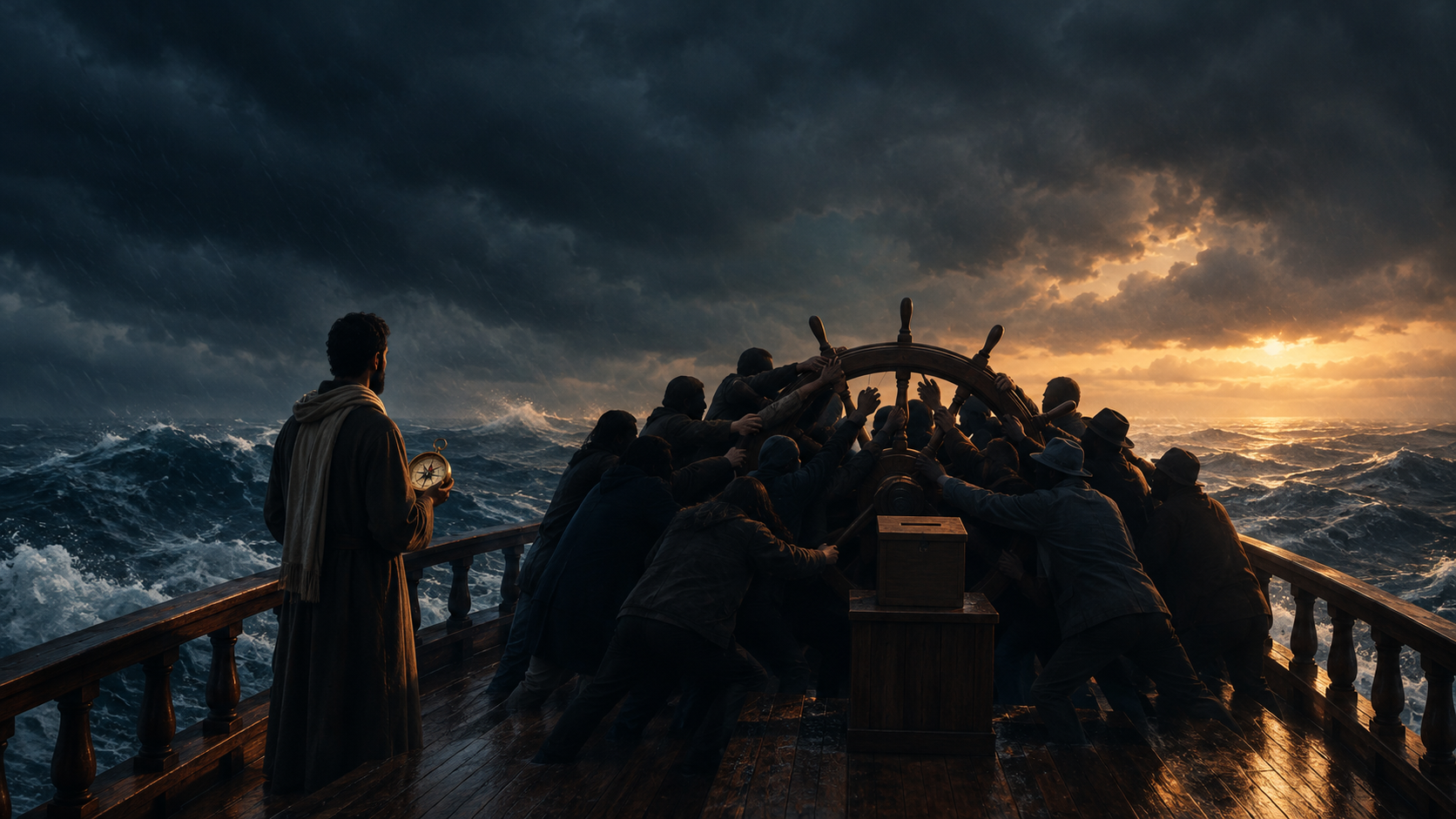
This question is old. Plato compared a country to a ship in Book VI of The Republic. If you were crossing a stormy sea, would you let the passengers vote on who steers, or would you want a trained captain who knows the stars and the weather? His teacher Socrates had been put to death in 399 BC by a jury of ordinary Athenians, which probably shaped that view. Aristotle was also wary of rule by the many when they rule only in their own interest.
My own tradition says something similar. The Quran asks whether those who know and those who do not know are equal. Islam gives every human being dignity, but it does not pretend that knowledge and ignorance carry the same weight.
Then why not simply ask for a test before voting? Because history shows what happens. In the American South, literacy tests were used to keep Black citizens from voting. Whoever writes the test controls the result. I get that, and I do not want a qualification exam for citizens.
The Real Problem Is Who Controls Education
Here is where I think most people miss it. The danger is not who decides who is qualified. The danger is that in a modern democracy, whoever wins power also decides what the education system looks like.
If you were a leader who wanted to stay in power forever, would you build great schools that teach children to question you? Or would you hand out small favors, keep people busy surviving, and offer entertainment? The Roman poet Juvenal described this around 2,000 years ago as “bread and circuses”. Give the crowd food and shows and they stop asking for anything else.
Look at the numbers in Pakistan. The Economic Survey 2025-26 puts the literacy rate for people aged 10 and above at 63 percent, and it notes that education spending went down. The old figure of about 25 million children out of school has been repeated for years. Newer surveys suggest enrollment may be higher than that figure implies, and the number is now disputed. But even the optimists admit that learning is the real crisis, because a large share of children cannot read a simple text at their age level.
An uneducated, anxious population is the easiest one to win votes from.
The 51 and 49 Problem
Here is the math that has bothered me for years. If a country has 100 people, and 51 of them are poorly informed while 49 are well informed, the poorly informed side wins every single time. That is simply how majority rule works.
I want to be fair about this, because it is not perfectly clean. Education and wisdom are not the same thing, and I just told you a story about a doctor who got fooled. Informed people vote badly too. But the basic point stands. A vote cast after months of studying policy counts the same as a vote sold for a small bribe or a slogan, and a system built on headcounts has no way to tell the difference.
Why Democracy Has Failed in Pakistan
In Pakistan, you can see this in the numbers. In the February 2024 general election, turnout was 47.6 percent according to the election monitor FAFEN, down from 52.1 percent in 2018. About 128.6 million people were registered and 60.6 million voted. Male turnout was 51.6 percent and female turnout was 42.6 percent. The election was also surrounded by disputes, including the fact that PTI’s electoral symbol was withheld and its candidates had to run as independents.
It gets worse. In by-elections held on November 23, 2025 across 13 constituencies in Punjab and Khyber Pakhtunkhwa, turnout fell to 28 percent from 51 percent in the 2024 vote in those same places. More than half the country, in some places more than seven in ten people, simply stays home.
Why? I see a mix of things. There is corruption. There is behind-the-scenes interference in who gets to rule. And there is a public that was never given the education to demand better. We also inherited a state built by the British to control and extract, not to serve. When the same families and party bosses keep returning, many of them would struggle to earn a mid-level job on pure merit, and ordinary citizens begin to feel their vote changes nothing.
Then the educated middle class gives up. They leave the country, or they stay and stop voting. That leaves the field to patronage networks, which makes the system even harder to fix. The cycle closes on itself.
When the Weak Students End Up Running the Show
A post went viral in Pakistan around that time and it made me laugh and wince. The writer said that in his school, the boys who were slapped by teachers and made to stand in the “murgha” position for being weak students are now mostly political workers and journalists. Many replied that it was the same in their classes.
I know this is a joke and not a study. It is also a stereotype, and plenty of honest and brilliant people work in both politics and journalism. But it spread because it touched something real. When a system rewards noise, loyalty, and street energy more than knowledge, then the loud rise and the careful leave. We even have a word for a certain kind of paid reporting, “lifafa” journalism, named after the envelope. Meanwhile the best students look for scholarships abroad.
Celebrities Should Not Have to Beg You to Vote
Another thing bothers me. Every election season, singers, actors, and cricketers appear on screens telling people to go out and vote because the future depends on it. If a system were truly delivering schools, hospitals, safe streets, and decent jobs, would anyone need celebrities to beg us to take part?
I will be fair again. Rich democracies run get-out-the-vote drives too. But I think the point still holds. Many thoughtful people stay home not because they are indifferent but because they have decided it is pointless, and that leaves the machine voters in charge.
Is Democracy Failing Everywhere?
I should not pretend Pakistan is the only place with this problem. The Economist Intelligence Unit’s Democracy Index hit a record low of 5.17 out of 10 in 2024, down from 5.52 in 2006. The 2025 edition showed a small uptick of 0.02 after eight straight years of decline, so the slide may be stopping, though other trackers disagree. Freedom House reported a twentieth year of decline, and V-Dem said democracy had fallen back to levels last seen in 1978 for the average person.
People themselves are unhappy too. A 2025 Pew survey across 23 countries found a median of 58 percent dissatisfied with how democracy works where they live. In the United States, 69 percent of adults told Pew in 2026 they were dissatisfied.
I also have to admit the other side. Norway tops the Democracy Index and shows what a working democracy can look like. Winston Churchill said in 1947 that democracy is the worst form of government except for all the others that have been tried. Islam has the answer, but that’s a topic for another post.
So Has Democracy Failed or Just Been Failed?
Here is where I land. When I say democracy has failed, I do not mean we should cancel elections. I mean the promise has failed. The promise was that ordinary people, given a vote, would build a better country. That only works if people are educated, informed, and free of fear and bribery. Nobody in power has an incentive to build that.
So the work is boring and slow. Fund real schools. Protect independent courts and election bodies. Make the people we elect answerable. And as individuals, we should keep putting facts out where silent readers can see them, even if the person arguing with us never gives in.
I used to feel angry that I wasted an afternoon on a thread about one word. Now I think it was worth it. It showed me exactly why democracy has failed so many people, and what we owe each other if we want it to work.
Frequently Asked Questions
Has democracy really failed?
It has failed in delivering what it promised in many countries, including Pakistan. Global scores are at or near record lows, though a few countries show it can work well.
Why is voter turnout so low in Pakistan?
Turnout was 47.6 percent in 2024 and only 28 percent in a set of 2025 by-elections. Distrust in the system, disputes over fairness, and economic pressure all play a part.
Does low education really hurt democracy?
It makes voters easier to sway with handouts and slogans, and it gives leaders little reason to improve schools.
You might also like Global Shifts