When I first read about the Tesla Roadster SpaceX thrusters, my honest reaction was a confused laugh, followed by a question I could not shake. Why? Why would anyone spend this much money, talent and time to make a sports car hop through the air? On October 15, 2026, Tesla showed off a redesigned Roadster at SpaceX’s test site in McGregor, Texas, and the world watched a car climb a ramp, hang upside down, launch itself, spin and land on bursts of compressed air. It was impressive to watch. It was also, in my view, a perfect example of technology chasing attention instead of solving a problem.
This post is my attempt to separate what actually happened from what the headlines wanted us to feel. I will lay out the facts first, then explain why I think the whole idea is a mockery of common sense, and then talk about where I believe all that energy should be going instead.
What Tesla Actually Showed at the Roadster Reveal
Let me start with the verified facts, because this story already sounds like fiction.
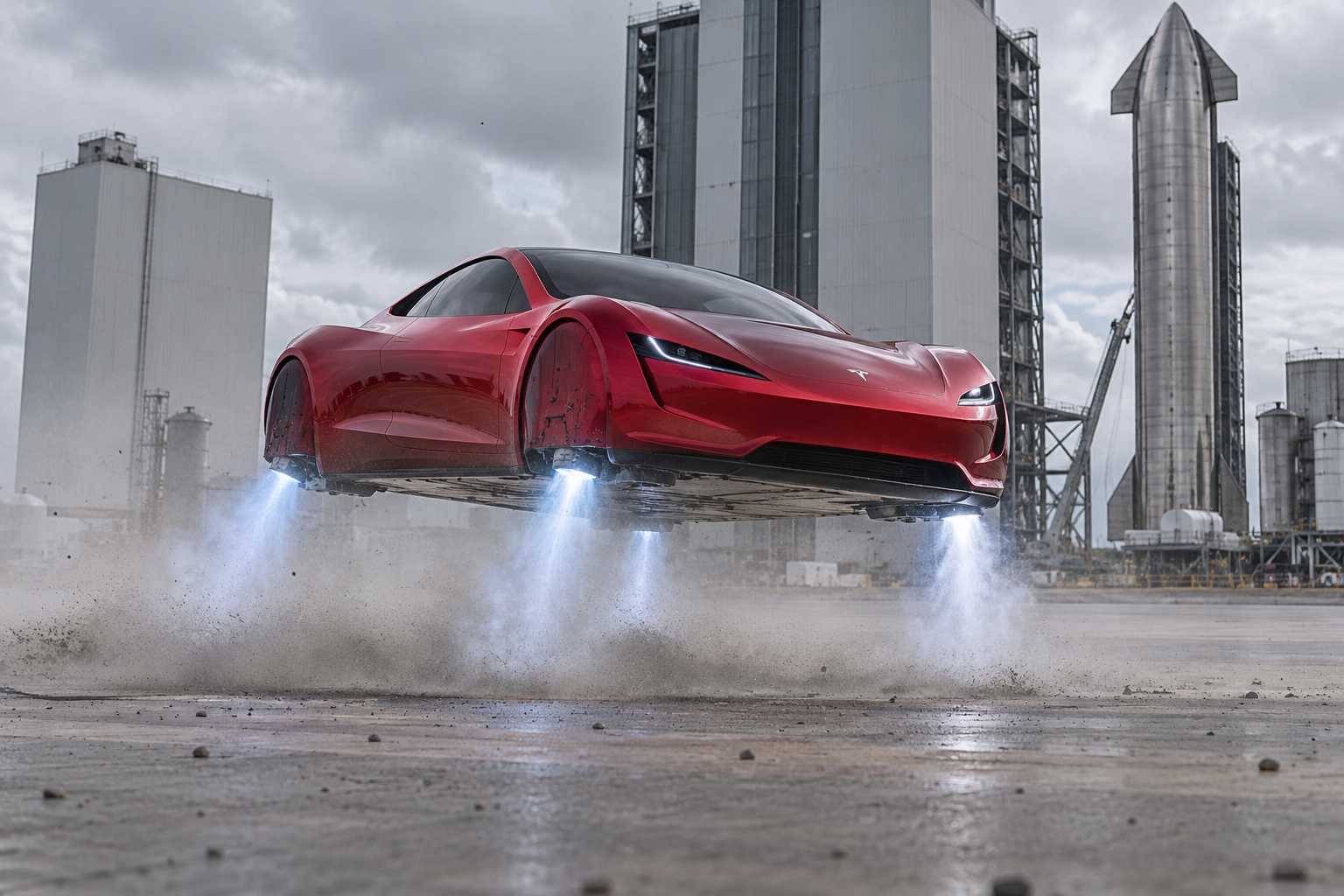
At the event outside Waco, Texas, Tesla’s new Roadster drove up a ramp that curved into a wall and then into an overhanging ledge. It hung upside down from that ledge using a fan-based suction system, launched itself off, did a barrel roll and landed softly on thrusters. It also hopped over a line of vehicles that reportedly included a Tesla Semi cab, a Cybertruck and a Model Y.
Nobody was driving. A mannequin in a SpaceX spacesuit sat behind the wheel, which is a callback to the cherry-red Roadster that SpaceX launched into space on the first Falcon Heavy flight in February 2018.
According to Tesla’s engineering vice president Lars Moravy, the car carries ten thrusters fed by about 600 liters of compressed air, stored in carbon-fiber overwrapped pressure vessels that fill “every usable void in the car.” These are cold-gas thrusters, which means there is no fire and no fuel burning. It is simply very high-pressure air being released through nozzles. Tesla claimed a 0 to 60 mph time of about 0.81 seconds when the thruster pack is used, and a top speed above 230 mph.
The Three Versions of the Roadster and the Fine Print
Here is where people get confused, so let me make it simple. Tesla is offering three trims.
- Performance: Called “road ready.” Two seats, active aerodynamics and the suction system. The reservation costs $50,000.
- Thrust: Called “race ready.” Two seats and rear-mounted cold-gas thrusters for the sub-one-second launch. The reservation costs $250,000.
- Rocket: Called “air ready.” One seat and ten thrusters around the body. This one is invite only, and you cannot simply reserve it.
No final price for the car itself has been announced. Musk says production starts in 2028. And while Tesla has not published a regulatory approval for any of the thruster features, reports say the flying version is unlikely to be certified for everyday road use.
One thing worth correcting, because I have seen it repeated online. Some summaries claim the deposit is only $5,000 and that the thruster car cannot be reserved at all. Based on the coverage I found, that is not accurate. The numbers above are the ones reported from the reveal.
A Nine Year Wait and a Very Loud Distraction
The Roadster was first shown in 2017 and was supposed to ship in 2020. Customers put down $50,000 deposits, and some paid $250,000 for one of 1,000 “Founders Series” cars. Since then the date moved to 2021, 2023 and 2024. A late 2025 reveal was promised, then April 1, 2026, then October 1, which was postponed because of severe weather. Now we are looking at 2028.
There is a name in psychology for this. It is called the planning fallacy, a term from Daniel Kahneman and Amos Tversky in 1979. People, and companies, consistently underestimate how long things will take, even when they have been wrong before. Add the sunk cost effect on top and you get thousands of people who have already paid, so they keep waiting, because walking away feels like admitting the money is lost.
Now imagine you are one of those reservation holders. You have waited close to nine years for a fast electric sports car. And what you get is a show where a driverless car with a mannequin does a barrel roll. Even a few well known voices online, including YouTuber Marques Brownlee, asked whether the announcement was a prank.
Why Rocket Thrusters on a Car Are Not a New Idea
Here is the point that bothers me most. Rocket thrusters are not new. We have had them for as long as rockets have existed. If putting thrusters on cars were a good idea, companies far older and far more established than Tesla could have done it decades ago.
And people did try. Fritz von Opel strapped rockets to cars in the 1920s. Sammy Miller built rocket dragsters in the 1970s. Those machines were thrilling, and they ran on closed, empty straightaways with trained people and a lot of respect for what could go wrong. Nobody sold one to the public as a daily driver. The reason is simple. It is not that the engineering was too hard. It is that it is unnecessary and it is dangerous. Rubber tires on asphalt already give us controllable grip. Planes, helicopters and drones already fly, and they do it far better than a four thousand pound car ever could.
The Rocket Launch Test That Changes How You See This
This is where I keep coming back to a simple picture. Think about any rocket launch you have watched. Everyone has their heart in their throat. Hands are clasped, fingers are crossed, and people pray to whatever higher power they believe in, because it is absolutely and utterly dangerous. One tiny error can blow the whole thing up in mid-air.
And that has happened. The Space Shuttle Challenger broke apart 73 seconds into its flight in 1986. In 2016, a SpaceX Falcon 9 exploded on its launch pad during a fueling test, and the investigation traced it to a failure in a high-pressure vessel. It is worth noting that the car’s pressure vessels are of the same family, and coverage of the reveal pointed out that this type of vessel has been linked to more than one SpaceX rocket failure.
Those launches are run by teams of highly trained engineers watching live data, with open ocean or restricted airspace around them. The idea that one day this kind of technology would be handed over to an average person who happens to have money is, to me, a mockery of common sense and human intellect. That is the whole point of my frustration. It is not that rockets are bad. It is that rockets belong in a place with professionals, checklists and a huge safety margin.
The Average Driver Problem
There is a classic study from 1981 by the Swedish psychologist Ola Svenson. He asked drivers to rate their own skill, and about 93 percent of the American drivers he surveyed said they were better than the median driver. That is mathematically impossible, and it shows how confident most of us are behind a wheel.
Now put that confident average driver in a car with a thruster system. Real roads have panicked drivers, distracted drivers and people who press the wrong pedal. A small mistake in a normal car is a fender bender. A small mistake in a car that can throw itself into the air on bursts of high-pressure gas is a very different kind of problem for everyone standing nearby.
And Musk himself did not exactly calm these fears. On a podcast he said that “safety is not the main goal” of the Roadster, comparing it to a Ferrari, and later softened this to say Tesla would “aspire not to kill anyone in this car.” He also said people who care a lot about safety should not buy it. I appreciate the honesty. I just do not think honesty fixes the problem.
A Crazy Guy With Money and the Water Bucket
I will say the quiet part the way I actually feel it. To me this feels like a crazy guy with money running all sorts of experiments while the parents are not home. I picture Elon Musk playing with a bucket of water, trying to find a way to gas it and light it on fire just to see what happens. That is the mentality I see here. It is not careful, it is not needed, and nobody asked for it.
I want to be fair. Musk has said the Roadster will have only a modest effect on revenue and called it a “halo” car, which is a flashy product meant to make the rest of the brand look exciting. That is a real strategy in the car industry, and it works because of something psychologists call the halo effect, first described by Edward Thorndike in 1920. When we are impressed by one thing, we tend to think better of everything connected to it. The thruster stunt dominates the news cycle, and people who never cared about Tesla start talking about Tesla. Some coverage even tied the event to speculation about a Tesla and SpaceX merger.
So yes, as marketing it works. But I would rather see a company get attention for a better product than for a better stunt.
What We Could Do With These Resources Instead
At the end of the day, I strongly believe that this much talent and money should go toward making the world a better place. I know it is hoping against hope. But when I look at the numbers, I cannot look away.
According to World Bank data tracked by Our World in Data, about one in ten people on Earth still live on less than $3 a day. The latest UN food security report, known as SOFI, estimates that around 673 million people faced hunger in 2024, which is about 8.2 percent of the world. The estimated range is 638 to 720 million, so the real number could be higher. The same report projects that roughly 512 million people could still be chronically undernourished in 2030.
I will be careful here. I am not claiming that the money spent on the Roadster could fix poverty and hunger, and I will not pretend I know the exact cost of the reveal. Poverty and hunger are complicated problems that involve politics, conflict, trade and infrastructure. My point is simpler than that. Money and brilliant engineers go where the attention and the returns are, and right now a hovering sports car gets more of both than clean water, farming resilience or basic healthcare. That is a choice, even if nobody feels like they are making it.
So, Is the Tesla Roadster SpaceX Thrusters Package Worth the Hype?
Here is where I land after reading everything I could find.
The engineering is real, and I do not want to take that away. Getting a car to launch, roll and land softly on cold-gas thrusters is clever work. Many people will find it exciting, and I understand why.
But a clever demo is not the same as a useful product. The thruster version is experimental, the flying trim is invite only, the production date is 2028 and the legal path for any of this on public roads is unclear. Meanwhile, the people who put down money almost nine years ago are still waiting for a car that simply drives well.
The Tesla Roadster SpaceX thrusters are a spectacle first and a product second. They show what is possible. They do not show what is needed. And in a world that still has hundreds of millions of people who are hungry, that gap is hard to ignore.
Frequently Asked Questions
Do the Tesla Roadster SpaceX thrusters use rocket fuel?
No. They are cold-gas thrusters that release compressed air through nozzles. No fuel is burned. The air is stored in carbon-fiber overwrapped pressure vessels, and Tesla says the tank is rechargeable.
How fast is the new Tesla Roadster?
Tesla claimed a 0 to 60 mph time of about 0.81 seconds when the thrusters are used, and a top speed above 230 mph. These are company claims from the reveal, not independently tested results.
Can you buy the flying Tesla Roadster?
Not in the usual sense. The “Rocket” version is invite only. The “Thrust” version can be reserved for $250,000, and the “Performance” version for $50,000. No final price has been announced, and Musk says production begins in 2028.
Will the Tesla Roadster with SpaceX thrusters be street legal?
That is unclear. No regulatory approval for the thruster features has been reported, and the flying version is unlikely to be certified for everyday road use.
When was the Tesla Roadster first announced?
In 2017. It was originally promised for 2020, and the date has slipped repeatedly since then.
Sources and further reading
- TechCrunch: Tesla reveals SpaceX-powered Roadster that flies and falls with style
- CNBC: Tesla unveils long-delayed Roadster developed with SpaceX
- Space.com: SpaceX thrusters just made a Tesla Roadster fly
- TechRadar: Elon Musk implores you not to buy a Tesla Roadster if safety is important to you
- WHO: Global hunger declines but rises in Africa and Western Asia (SOFI 2025)
- Our World in Data: Tracking how many people live on less than $3, $10, or $30 a day
You Might also like