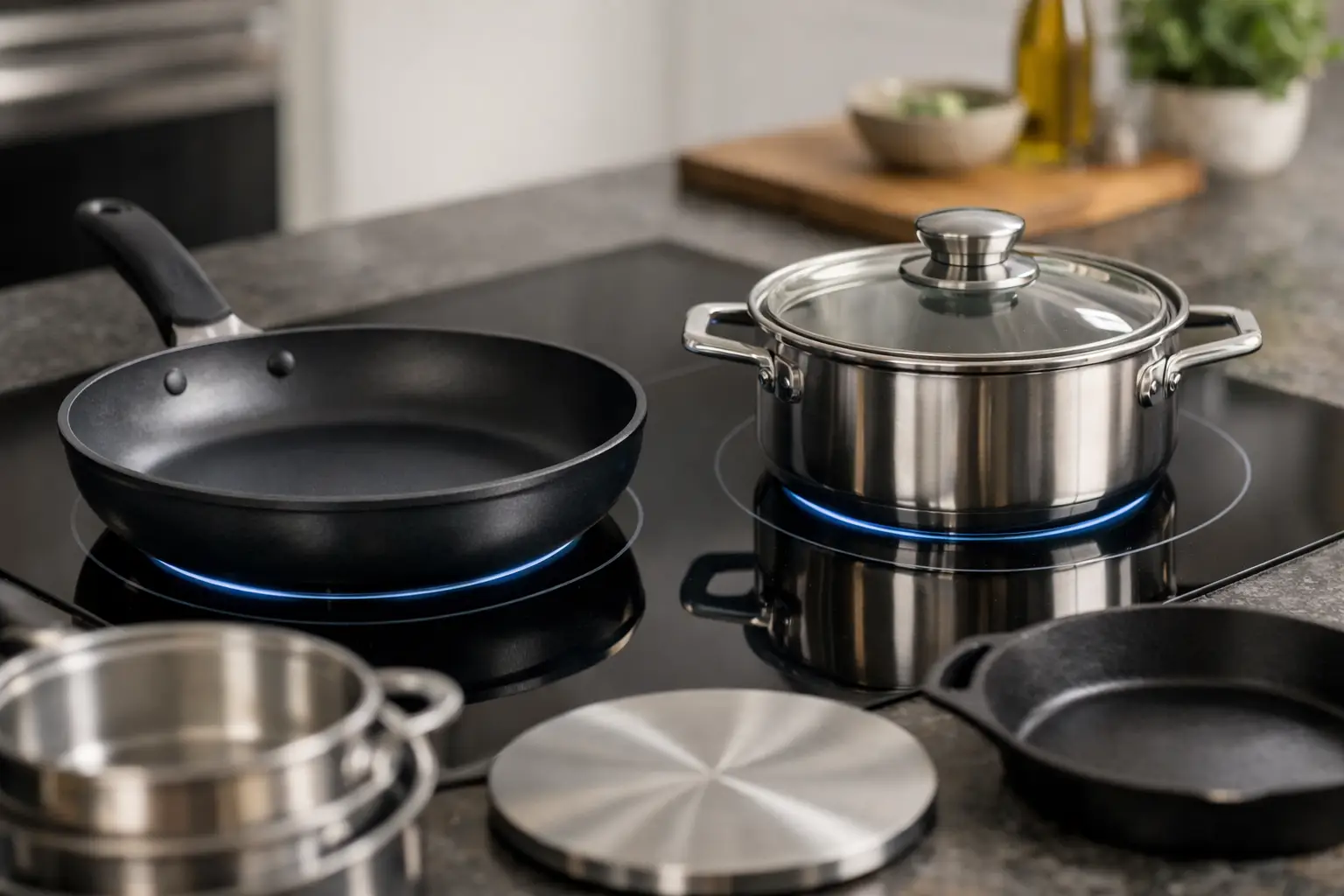
That pan you loved on gas can turn into dead weight on induction. If you’re figuring out how to choose induction cookware, the real question is not just whether a pan works. It is whether it fits the way you cook, heats predictably, and holds up under daily use without wasting the speed advantage induction gives you.
Induction is less forgiving than traditional electric or gas because the cooktop is reacting to the pan itself. That shifts the buying logic. Marketing claims matter less than base construction, flatness, magnetic response, and how the cookware behaves when heat ramps up fast.
How to choose induction cookware without guessing
Start with the pan’s base, not the brand name. Induction requires ferromagnetic material, which means the cookware needs a magnetic layer that the cooktop can detect. Stainless steel can work, but not all stainless steel does. Aluminum and copper usually need a bonded magnetic base. Cast iron is typically compatible, though its weight and surface texture create other trade-offs.
The fastest reality check is a magnet. If a magnet sticks firmly to the bottom, the pan is likely induction compatible. That does not mean it is a good induction pan. A weak magnetic pull can signal uneven response. A thin base can still create hot spots. A warped bottom can buzz, rock, or lose contact with the cooking zone.
For advanced home cooks, the best purchase filter is simple: prioritize full-contact, heavy-bottom cookware with a flat, stable base. That one rule cuts through most bad options.
The base matters more than almost anything else
On induction, the base is the engine room. A well-built pan has enough mass to distribute fast energy input without scorching one area while leaving another behind. This is why cheap induction-ready cookware often disappoints. It technically works, but it does not cook well.
Clad stainless steel is the safest all-around choice for most kitchens. Tri-ply or five-ply cookware with an aluminum or copper core and magnetic stainless exterior offers a strong balance of responsiveness, heat distribution, and durability. If you want one system that can sear, saute, simmer, and handle acidic ingredients, this is usually the smart play.
Disc-bottom pans can also perform well, especially stockpots and saucepans, but quality varies more. A thick, well-attached disc can be efficient and stable. A thin one tends to create a visible heat ring, especially on larger burners.
Cast iron performs beautifully on induction when you want heat retention for steak, shallow frying, or hard searing. It is slower to respond and heavy enough to be annoying for everyday pan work. On glass induction tops, rough cast iron can also scratch if handled carelessly.
Carbon steel sits in an interesting middle lane. It works on induction, heats faster than cast iron, and excels for high-heat cooking once seasoned well. But lower-cost carbon steel pans sometimes warp under aggressive heat changes, which matters more on induction than many buyers expect.
Choose material based on cooking style, not hype
A lot of cookware advice becomes useless because it treats every kitchen the same. A better system is to match material to your actual workflow.
If you cook eggs, fish, and delicate proteins several times a week, a quality induction-compatible nonstick skillet earns its place. Look for a thicker base and a clearly stated induction layer. Cheap nonstick pans often heat unevenly and age fast on induction because the heat transfer is intense and concentrated. Treat nonstick as a replaceable specialist, not a forever pan.
If your cooking skews toward pan sauces, pasta, braises, and daily stovetop work, stainless steel is usually the best core system. It handles temperature changes well, tolerates metal tools better than nonstick, and moves between cooking tasks without much fuss.
If you mostly sear meat, blister vegetables, and cook over high heat, carbon steel or cast iron can outperform stainless in specific tasks. The trade-off is maintenance, weight, and less flexibility with acidic foods.
For most serious home setups, the smartest answer is not one material. It is a small system: stainless for daily range, nonstick for low-stick tasks, and one heavy carbon steel or cast iron piece for high-heat work.
Sizing is where many buyers get it wrong
Induction cookware has to match the cooking zone more closely than gas cookware does. If the base is too small, some cooktops will not activate properly. If it is too large relative to the burner, heating can become less even, especially on weaker consumer models.
This matters most with frying pans. Manufacturers advertise pan diameter, but the critical measurement is the induction contact area on the bottom. A 12-inch skillet might only have a 9-inch flat base. If your primary cooking zone is smaller than that, performance can fall off at the edges.
When possible, build your cookware set around your cooktop’s actual burner sizes. For many households, that means a 10-inch skillet is the true workhorse, not a 12-inch pan. It is lighter, fits more burners efficiently, and gives better contact on average.
Tall pots are more forgiving because liquids moderate heat movement. Frying pans expose every weakness in construction, burner matching, and flatness. If budget is limited, spend more on the skillet than the stockpot.
Weight, flatness, and handle design all affect performance
A pan that works on induction but rocks on the surface is a bad pan. Flatness is not a minor detail. It affects contact, noise, heat transfer, and control. Induction rewards precision, and warped cookware loses that advantage quickly.
Heavier is often better, but only to a point. A thicker base improves stability and heat distribution. Too much total weight can turn everyday cooking into a chore, especially with large saute pans full of food. If you cook often, ergonomics matter as much as raw thermal performance.
Check the handle design. Long handles should feel balanced when the pan is loaded, not just when it is empty on a shelf. Riveted handles are common and durable, but they create cleaning points inside the pan. Welded interiors are cleaner but vary in durability by manufacturer. Helper handles on larger pans are worth having if you cook for a family or batch-cook regularly.
Beware of induction-ready labels that tell you very little
“Induction compatible” is a floor, not a quality standard. It tells you the cooktop will likely recognize the pan. It does not tell you how evenly it heats, how resistant it is to warping, or whether the magnetic layer is full base or just a token disc.
Look for signs of serious construction: stated ply count if relevant, base thickness, fully clad design, oven safety, and a reputation for maintaining flatness. If the product description is vague and leans heavily on aesthetics, that is usually a signal.
Noise is another overlooked clue. Some induction pans hum lightly at high power, which is normal. Excessive buzzing can point to weaker pan-to-cooktop interaction or uneven base design. You may not know this before buying, but it is one reason experienced cooks tend to favor established cookware lines over bargain bundles.
How to build an induction cookware system on a realistic budget
You do not need a full set on day one. Sets often include filler pieces that eat budget and cabinet space. A tighter system usually performs better.
Start with three pieces: a 10-inch or 11-inch stainless skillet, a 2- to 3-quart saucepan with a lid, and a 6- to 8-quart stockpot or Dutch oven depending on your cooking style. Add one nonstick skillet if eggs or pancakes are part of your weekly routine. Add carbon steel or cast iron if high-heat searing matters to you.
This approach gives you coverage across most home cooking tasks without forcing you into one material for everything. It also lets you spend more on the pieces that actually do the work.
If you are replacing cookware gradually, prioritize pans you use on high heat first. Those are the pieces where poor induction performance shows up fastest.
A quick test before you commit
If you can handle cookware in person, put a straight visual check on the base. It should look flat and substantial, not crowned or flimsy. Lift it by the handle and imagine tossing vegetables or pouring sauce from it. If the balance feels off empty, it will feel worse full.
If you already own pans and want to audit them, test each one with a magnet, then run a simple cooking trial. Heat the pan on medium with a thin layer of oil or water and watch how evenly the surface responds. Fast is good. Fast and patchy is not.
The right cookware makes induction feel better, not just faster
There is a difference between cookware that merely functions and cookware that makes induction worth owning. The right pans stay flat, respond cleanly, and give you repeatable results when the cooktop moves from low simmer to aggressive heat in seconds. That is the real buying standard.
If you approach cookware like a system instead of a shopping spree, you will make better calls. Buy for your burner sizes, your weekly cooking habits, and the heat behavior you actually need. The best induction setup is not the biggest set or the most expensive finish. It is the one that makes your kitchen run with less friction every night.