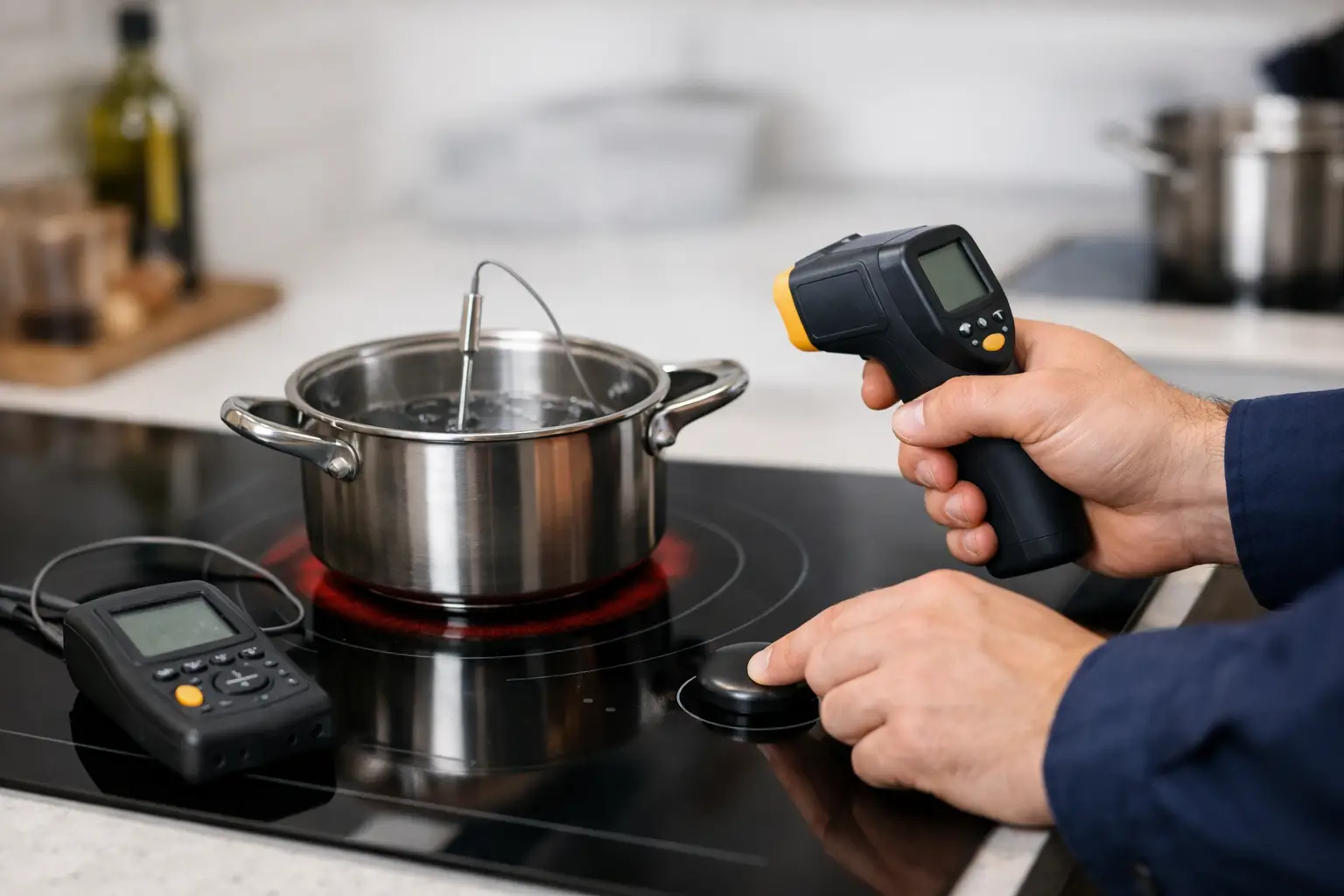
A pan that scorches onions at level 4, takes forever to simmer at level 7, or shuts off mid-service creates the same question: how to calibrate induction cooktops. The useful answer is less glamorous than a hidden reset code. Most residential induction cooktops do not offer user-accessible calibration. What looks like a calibration issue is usually a cookware, electrical, ventilation, sensor, or control-setting problem.
Treat the cooktop like a system, not a single appliance. Induction is fast enough to expose weak cookware and sloppy heat habits that gas ranges often conceal. Before assuming the unit is defective, run a controlled test, document the behavior, and separate normal induction cycling from a problem that needs service.
What “calibration” means on an induction cooktop
On many consumer models, factory calibration lives inside the control board and temperature-sensing system. A technician may verify sensors, power output, and safety cutoffs using manufacturer procedures. The owner can usually adjust only operational settings: power level, boost mode, bridge zones, timer behavior, child lock, and sometimes temperature presets.
That distinction matters. Opening the cooktop or attempting to adjust internal components can damage the glass, compromise electrical safety, and void the warranty. A 240-volt induction circuit is not an appliance-repair learning project.
For an advanced home kitchen, practical calibration means building a reliable map between the cooktop’s numbered settings and the results in your pans. You are not rewriting the appliance firmware. You are verifying that the hardware behaves consistently, then setting up cookware and workflow around its real output.
Start with a controlled heat test
Do not diagnose an induction cooktop while making dinner. Sauce, cold ingredients, crowded pans, and changing burner sizes create too many variables. Use a repeatable test with one compatible pan and measured water.
Choose a flat-bottomed, magnetic stainless steel or enameled cast-iron saucepan that matches the diameter of the cooking zone. Avoid thin disc-bottom cookware for the first test. It can heat unevenly, warp slightly, and create false evidence of poor control.
Add one quart of room-temperature water, place the pan centered on the zone, and use the same zone for every test. Record the time needed to reach three landmarks: visible steam, a gentle simmer, and a rolling boil. Then repeat on another day. Exact timing varies by wattage, pan construction, altitude, and water temperature. Consistency matters more than a universal benchmark.
Next, reduce the setting to a low level and watch the water for five minutes. A good induction cooktop may cycle power on and off at lower settings. That is normal. The goal is not a perfectly motionless water surface. The goal is repeatable heat behavior without sudden shutdowns, error messages, or wildly changing results.
If the same pan and volume produce dramatically different outcomes on the same zone, document it with the control setting, date, and any displayed code. That record is far more useful to support or a technician than saying the cooktop “runs hot.”
Do not use an infrared thermometer as your verdict
Infrared thermometers read surface temperature, and glossy stainless steel is a poor target. The reading can be misleading by dozens of degrees because reflective metal interferes with the instrument. A probe thermometer in water is useful for checking a simmer or boil. For pan work, judge performance through repeatable cooking tests: butter melting, controlled sautéing, and how quickly a measured amount of water responds.
If your unit has a temperature-control mode with a paired sensor or compatible pan, follow that manufacturer-specific procedure. These systems can be accurate within their intended setup, but they are not universal across every pan in your cabinet.
Check the variables that mimic a bad calibration
The most common fix is cookware, not electronics. Induction creates heat in the pan, so the pan is part of the appliance. A lightweight skillet with a thin magnetic layer can develop hot spots even when the cooktop is operating correctly. A heavy tri-ply or clad pan spreads that energy more evenly and makes lower settings easier to use.
Pan diameter is equally important. A small pan on a large zone may heat, but the active coil pattern can concentrate energy in the center. An oversized roasting pan may not be detected reliably or may only activate part of a flexible zone. Match the pan base, not the rim, to the marked zone whenever possible.
A warped base introduces another issue. The cooktop can still detect the pan, but poor contact and an uneven heating surface produce erratic browning. Put the cold pan on a flat counter and press gently around the rim. If it rocks, retire it from precision work.
Power management can also be misread as a calibration failure. Many cooktops share available wattage between paired zones. Running Boost on one zone may limit the output of its neighbor. This is normal load management, especially on 30-inch units with multiple active burners. Check your manual for which zones are paired, then test one zone at a time before deciding anything is wrong.
Ventilation is another hidden constraint. Induction electronics generate heat below the glass. If the cooling intake is blocked by a crowded drawer, installation debris, or a failed fan, the cooktop may reduce output or shut down to protect itself. Listen for the cooling fan after a high-power session. Fan noise is expected. Repeated overheating warnings or a fan that never runs under heavy load deserves professional attention.
How to calibrate induction cooktops for daily cooking
Once the appliance passes a controlled test, create a working heat map. This is the part that changes your cooking immediately. Gas-trained cooks often treat a numbered induction setting as a flame-size equivalent. It is not. Level 6 on one model may be a serious sauté setting, while level 6 on another is close to medium-low.
Use one reliable skillet and establish four reference points. Find the lowest setting that holds melted butter without browning, the setting that maintains a steady simmer in a small saucepan, the setting that cooks eggs without aggressive sizzling, and the setting that sears a dry protein efficiently. Write these down in a note on your phone for the first week.
For many cooktops, a practical workflow looks like this: preheat at a moderately high setting, add food, then lower the power sooner than instinct suggests. Induction transfers energy so quickly that leaving a pan at its preheat setting is a common cause of scorched aromatics and broken pan sauces. It is not proof that the cooktop needs adjustment.
Use Boost selectively. It is excellent for boiling pasta water or rapidly heating a large stockpot. It is rarely the right setting for an empty skillet, delicate cookware, or a crowded weeknight line of multiple pans. Repeated Boost use also makes shared-zone power limits more visible.
If your cooktop allows power-level limits or an installer menu, do not change those settings casually. Some models can be configured for lower-amperage installations, and reduced maximum power can feel like poor performance. Confirm the electrical specification and installation setup with the manual or a qualified technician before changing anything.
When the issue is service, not technique
Call for warranty support or a qualified appliance technician if a zone fails to detect known-compatible cookware, displays recurring error codes, trips the breaker, makes unusual clicking after startup, or heats markedly differently during controlled tests. Also act quickly if the glass is cracked, the touch controls respond unpredictably, or the cooktop shuts down under normal use with clear ventilation.
Before the appointment, collect the model number, serial number, installation date, photos of error codes, and your test notes. Mention the cookware used, pan diameter, and whether the behavior happens on every zone or only one. That information narrows the diagnosis from the start and reduces the chance of a vague, expensive service visit.
Do not attempt internal sensor adjustment, board replacement, or wiring work unless you are qualified to service high-voltage appliances. The right repair may be simple, but the risk and diagnostic uncertainty are not.
A well-run induction station rewards disciplined setup. Build your heat map with good pans, keep the cooling path clear, and test one variable at a time. Once you know what each zone actually does, the cooktop stops feeling unpredictable and starts behaving like the fast, precise production tool it was designed to be.