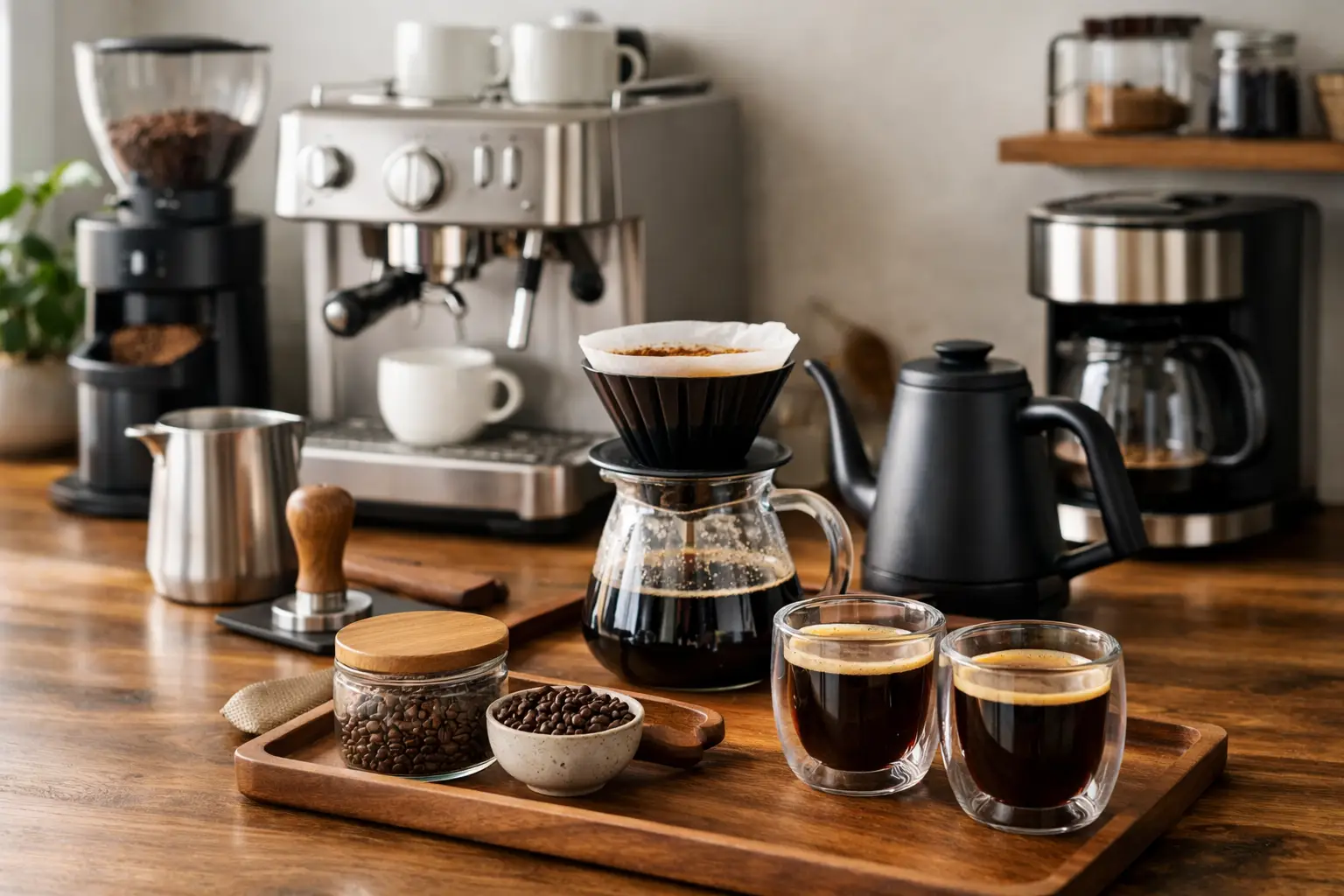
Most home coffee setups fail for one boring reason: the gear is fine, but the system is sloppy. Beans sit too close to heat, filters disappear when you need them, the grinder takes over the counter, and the morning routine turns into a small domestic negotiation. A good home coffee station gear guide should fix that. It should help you build a setup that makes better coffee, wastes less time, and still looks intentional in a real kitchen.
This is not about buying every shiny tool in the specialty coffee ecosystem. It is about choosing the few pieces of gear that match your habits, your space, and the kind of coffee you actually drink Monday through Friday.
The best home coffee station gear guide starts with workflow
Before you pick a brewer, map the station like a workstation. Water source, kettle, grinder, brewer, mugs, scale, filters, and bean storage should sit in the order you use them. If you have to pivot across the kitchen three times to make one cup, the setup is broken even if every item is premium.
A strong home coffee station usually lives in one of three formats. The first is a compact countertop zone for apartments and busy family kitchens. The second is a dedicated sideboard or bar cart setup that keeps visual clutter away from the main cooking area. The third is a hybrid office-coffee station for people who work from home and want caffeine near their desk without turning the office into a break room.
The right format depends on space, but the principle stays the same: minimize steps, hide the mess, and keep the daily tools within one arm span.
Start with the grinder, not the brewer
If the budget only stretches for one serious upgrade, make it the grinder. A mediocre brewer with a good burr grinder can produce impressive coffee. An expensive brewer paired with inconsistent grounds usually cannot.
For most households, a burr grinder is the center of the station. Blade grinders are cheap, noisy, and uneven. They create too much fine dust and too many large chunks, which makes extraction inconsistent. Burr grinders cost more, but they give you control. That matters whether you brew drip, pour-over, French press, or espresso-style drinks.
Flat burr and conical burr grinders both have their fans. In practical home use, the bigger question is retention, noise, size, and adjustment range. If you switch between brew methods often, you want a grinder with clear settings and low frustration. If you make the same batch every morning, reliability matters more than endless tweakability.
Single-dose grinders look clean and reduce stale grounds, but they ask more from the user. Hopper-based grinders are faster for households making several cups a day. That trade-off matters. Coffee people love precision. Real kitchens love speed.
Choose a brewer for your weekday reality
People often buy brewers for their weekend self, then resent them by Tuesday.
If your goal is speed and consistency for multiple drinkers, a quality automatic drip machine is still one of the smartest purchases you can make. Good models now hold proper brew temperatures, saturate grounds evenly, and remove a lot of user error. For households with kids, early meetings, or split schedules, this is usually the highest-value choice.
If you care about flavor clarity and you enjoy a slower ritual, a pour-over setup earns its place. It takes less space than a drip machine and can produce exceptional results, but it also demands attention. Water temperature, pour pattern, timing, and grind all matter. If that sounds appealing, great. If it sounds like unpaid labor before 7 a.m., skip it.
French press is durable, forgiving, and good for people who prefer body over brightness. AeroPress is compact, flexible, and ideal for small kitchens or travel crossover use. Espresso machines are their own category entirely. They can anchor a beautiful station, but they also introduce cost, maintenance, warm-up time, milk workflow, and a steeper learning curve. Buy into home espresso only if you actually want the hobby, not just the aesthetic.
The support gear that quietly makes the station work
The most important tools after the grinder and brewer are less glamorous. A gooseneck kettle matters for pour-over precision, but if you use drip or French press, a standard fast-boil kettle may be the smarter choice. Matching the kettle to the brew method prevents overspending on features you will never use.
A digital scale is worth it. Not because coffee has to become obsessive, but because repeatability is the fastest route to better results. Scoops create guesswork. A scale gives you a stable ratio you can adjust once and keep.
Storage also deserves more attention than it gets. Beans degrade from air, light, heat, and moisture. A station placed next to the stove may look efficient and still be a bad idea. Use opaque or low-light storage with a solid seal, and keep only the working quantity at the station. Bulk backup should live elsewhere in a cool cabinet.
Then there is the waste system. If your station has no obvious place for used filters, spent grounds, and quick wipe-down tools, mess starts to spread. A small knock box for espresso users, a compost container for grounds, or even a discreet lidded bin nearby changes the experience more than another premium accessory ever will.
Counter space is the real luxury
A coffee station should not compete with your kitchen for survival. It should occupy a defined footprint and stay inside it.
That means thinking vertically. Mug hooks under a shelf, slim drawers for filters and stirrers, stackable canisters, and a tray to visually contain the setup all help. Trays are underrated because they turn separate objects into one organized zone. They also make cleaning easier. Lift, wipe, reset.
If the station is visible all day, reduce visual noise. Keep packaging off the counter. Decant filters, pods, or beans into containers that are easy to use and easy to refill. Leave out the daily tools. Store the occasional ones. The line between curated and cluttered is usually just one extra appliance too many.
Build for your actual drink menu
Your gear should follow your drink habits. If you mostly drink black coffee, put your money into grinder quality, bean storage, and brew consistency. If you make lattes every day, milk steaming and cup clearance suddenly matter a lot more than a boutique dripper.
For mixed households, a flexible setup usually beats a purist one. A drip machine for volume plus a small manual option for the coffee enthusiast can coexist nicely. Trying to force one brewer to satisfy every taste often leads to compromise nobody loves.
This is also where water enters the conversation. If your tap water tastes off, your coffee will too. You do not need a lab-grade water program, but filtered water is one of the simplest upgrades available. It protects flavor and, in many machines, reduces scale problems over time.
The upgrade path most people should follow
If you are building from scratch, resist the urge to buy the final form all at once. The better move is staged investment.
Start with a capable grinder, a brewer that matches your schedule, a scale, and proper storage. Use that setup for a month. Watch what annoys you. Maybe the issue is not extraction quality at all. Maybe it is cable mess, slow kettle recovery, or the fact that your mugs live across the room.
After that, upgrade the bottleneck. Serious stations are rarely built by buying the most expensive item first. They improve through friction reduction. That is the systems mindset advanced home cooks already understand in the rest of the kitchen.
This is where NawaMag readers tend to make smarter decisions than average shoppers. They do not just ask, “What is the best gear?” They ask, “What setup produces the best repeatable result with the least wasted motion in my space?” That question leads to better coffee and fewer regret purchases.
A few expensive mistakes to avoid
The first mistake is over-indexing on aesthetics. A beautiful espresso machine on a weak grinder is still a weak setup. The second is buying too much brewer overlap. If two devices solve the same problem in nearly the same way, one of them will collect dust.
The third is ignoring maintenance. Coffee oils build up. Water leaves scale. Milk systems demand cleaning discipline. Choose gear you will actually maintain, especially if your mornings are already tight. High-performance equipment becomes bad equipment fast when cleaning is annoying.
The fourth is treating the station as decor instead of infrastructure. Good stations are attractive because they are coherent, not because they are crowded with accessories.
What a finished station should feel like
A strong coffee station feels quiet. You can make a cup half-awake without opening six cabinets. The beans are fresh, the tools are where they should be, cleanup takes a minute, and the setup earns its footprint every day.
That is the real target of any home coffee station gear guide. Not maximal gear. Not cafe cosplay. Just a tight, dependable system that turns one daily habit into a cleaner, better ritual.
If you are deciding what to buy next, start with the step that saves time every morning. Better coffee is nice. A setup you keep using is better.