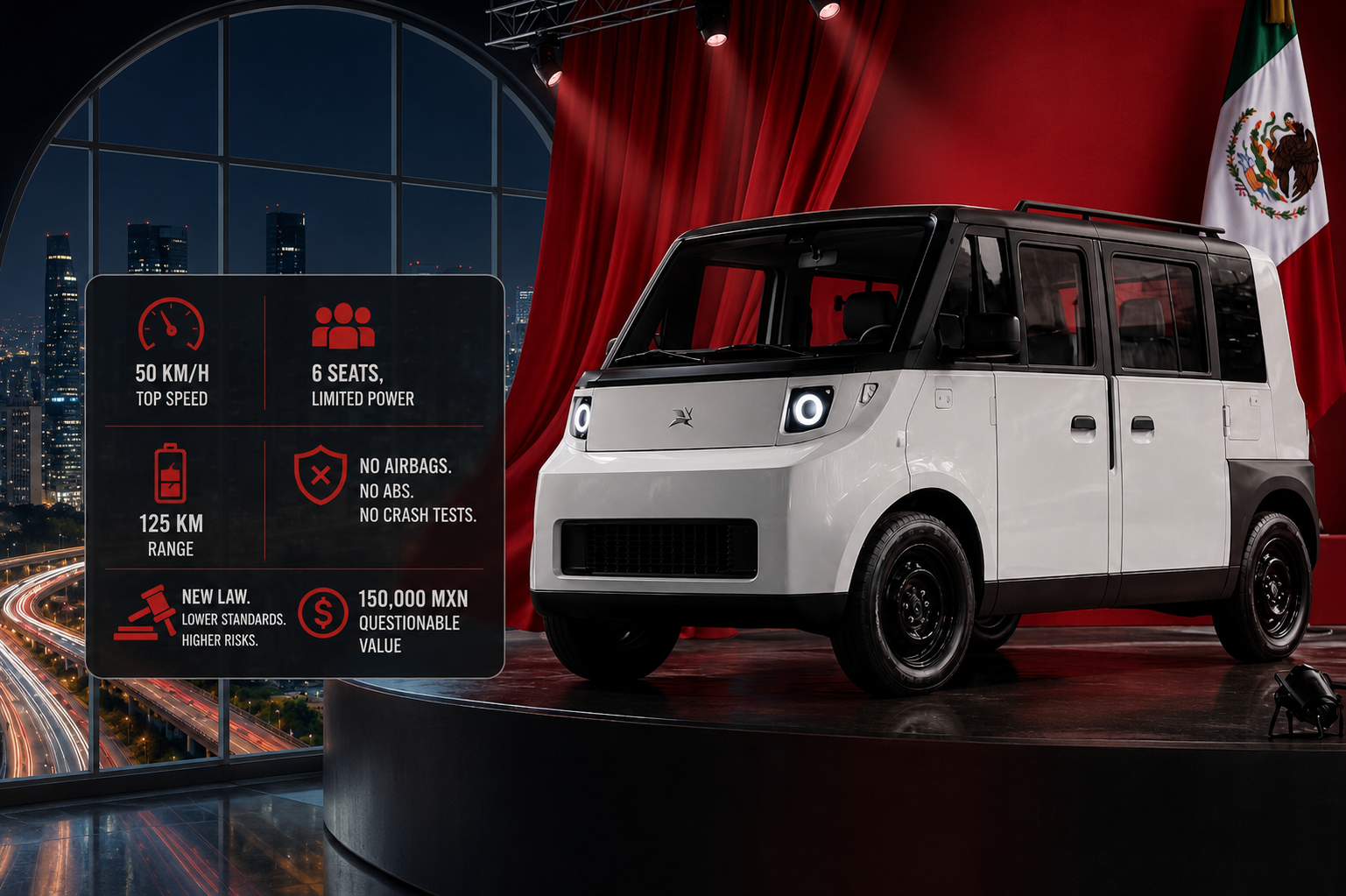
When President Claudia Sheinbaum walked into a government hangar to unveil the Olinia Uno, Mexico’s first domestically developed electric vehicle, the moment was designed to generate a specific feeling. National pride. Technological ambition. A country building its own future. The news spread quickly, and the vehicle’s name, drawn from the Nahuatl word ollin meaning “movement,” carried a deliberate symbolism that the administration was happy to amplify.
What the headlines did not examine closely enough is what the vehicle actually is, how it performs, what it cannot do, and whether any of it serves the people it was announced to serve.
A close reading of the specifications, the regulatory strategy, and the driving culture this car will enter reveals a project that makes a great deal of sense as a political moment and very little sense as a transportation product.
What the Olinia Uno Actually Is
The Olinia Uno is a six-passenger, boxy, tall-bodied urban micro-vehicle with the following core specifications:
- A starting price of 150,000 pesos, which is approximately 8,600 US dollars
- A 13.5 kW electric motor paired with a 14.7 kWh battery
- A stated range of roughly 125 kilometers
- An electronically capped top speed of 50 kilometers per hour
- Charging through a standard 110-volt household outlet
- An IP67 water-resistance rating for the motor and battery
- Disc brakes at the front and seatbelts throughout
The name Olinia comes from a state university research program. The design intent, as described by the development team, was to engineer a vehicle specifically for Mexican urban reality rather than to imitate what global automakers produce. The team prioritized affordability, rough-road capability, waterproofing for flooded streets, and the ability to charge without any specialized infrastructure.
On a whiteboard, these choices have a logic to them. Applied to actual Mexican roads, with actual Mexican drivers, they collapse one after another.
The Speed Problem Is Not Minor
A top speed of 50 kilometers per hour is not a conservative safety measure. It is a structural barrier that makes this vehicle dangerous to operate on the roads it would realistically be used on.
Mexico City arteries such as Paseo de la Reforma , Anillo Periférico, and Circuito Interior regularly carry traffic moving at 60 to 90 kilometers per hour. Major avenues in cities like Querétaro, Guadalajara, and Monterrey follow similar patterns. A vehicle that is physically incapable of exceeding 50 kilometers per hour does not slow traffic down slightly. It creates a moving obstacle that forces every vehicle behind it to brake suddenly, switch lanes, or make aggressive passing maneuvers.
The real-world ceiling is actually lower than the stated maximum. Under a full load of six passengers, on a normal road with any incline at all, the Olinia will likely operate at 35 to 45 kilometers per hour. That is its functional speed in daily use.
For comparison, the smallest entry-level motorcycles sold in Mexico, including basic models from brands like Italika, routinely exceed 80 to 100 kilometers per hour. A motorcycle with a fraction of the Olinia’s price can keep pace with traffic. The Olinia, at six times the cost of a basic Italika, cannot.
The government’s answer to this problem is a new legal category. Officials are working with the Ministry of Economy to classify the Olinia as a “low and medium speed” vehicle, or minivehiculo. This categorization allows the vehicle to bypass the safety and performance testing that highway-legal passenger cars must pass. It is not a design solution. It is a regulatory workaround that keeps the sticker price low by removing the legal obligation to build the car properly.
Six Passengers, a 13.5 kW Motor, and the Laws of Physics
The Olinia’s marketing leans on its six-passenger capacity as evidence of practical value for Mexican families. The engineering reality contradicts this.
A 13.5 kW motor is small by any automotive standard. Comparable low-speed neighborhood electric vehicles in the United States, which are purpose-built for retirement communities and campuses, use motors in similar ranges and no one expects them to handle Mexican urban traffic.
When that motor is asked to move six adults up a grade, as it would regularly encounter in Mexico City’s western neighborhoods, in parts of Estado de Mexico, or in the hillside sections of cities like Querétaro and Oaxaca, the performance drop is immediate. Battery drain accelerates. Speed falls further below the already limited ceiling. The 125-kilometer stated range assumes ideal conditions that do not match how the vehicle would actually be used.
The six-seat configuration also requires an extremely upright and compressed interior layout to achieve any meaningful capacity in a micro-footprint frame. Comfort under full load will be minimal. Suspension wear under regular maximum-payload use will be significant. These are not abstract concerns. They are the predictable consequences of the engineering decisions made to hold the price at 150,000 pesos.
Safety: What Was Left Out
The Olinia Uno, as presented, has:
- Seatbelts
- Front disc brakes
- An IP67-rated motor and battery pack
It does not have:
- ABS, the anti-lock braking system that prevents wheel lockup during emergency stops
- Electronic stability control
- Airbags of any kind
- Crash-tested crumple zones
Mexico’s NOM-194 standard requires that all conventional passenger vehicles sold in the country carry dual airbags, ABS, and stability control as a baseline. The Olinia bypasses these requirements entirely through the minivehiculo classification. The administration did not find a way to meet these standards at a lower price point. It reclassified the vehicle to make the standards inapplicable.
Consider the practical consequence on a rain-slicked avenue. An Olinia carrying six passengers is moving slowly when an SUV approaches from behind at 70 kilometers per hour. If the Olinia driver needs to brake suddenly for traffic ahead, the lack of ABS will cause the wheels to lock, forcing a skid. With no room to maneuver, the SUV crashes into its rear. Because the Olinia lacks engineered crumple zones or airbags, the impact energy is transferred directly into the cabin. There is nothing to shield the people inside except a thin metal and composite frame.
Describing this vehicle as transportation for low-income families, who have fewer resources to absorb the consequences of a serious accident, while stripping out the safety features that protect those families, is not a pro-people policy decision. It shifts the risk entirely onto the consumer.
The Driving Culture Variable
Any honest analysis of a vehicle designed for Mexican streets has to account for how people actually drive on those streets.
The theoretical model assumes that Olinia drivers will stay in designated local lanes, observe their vehicle’s speed limitations, and avoid high-speed arterials. This is not how behavior works in practice, anywhere, but it is especially disconnected from the driving culture in Mexican cities.
If a person buys something with four wheels, a roof, and six seats, they will treat it as a car. They will merge onto Constituyentes with it. They will take it onto the distribuidor vial to cross town. They will drive it the way they drive everything else, because that is how roads work, and because the alternative of being confined to back streets at 40 kilometers per hour is not a practical urban commuting option for most people.
This is not a criticism of Mexican drivers as a unique category. It is a description of human behavior. People use the tools available to them in the way those tools need to be used to function in their daily lives. A vehicle that cannot safely do what drivers need it to do will still be asked to do those things, and the consequences will fall on the people inside it.
What the Chinese Market Already Offers
The comparison to Chinese electric vehicles currently in the Mexican market exposes the Olinia’s value proposition in a direct way.
At the low end of the Chinese import market, unofficial micro-cars from platforms like Alibaba arrive for between 25,000 and 40,000 pesos. These are essentially enclosed plastic carts. They are illegal to drive on Mexican public roads. They have no valid vehicle identification numbers, no customs compliance, and no safety standards. They are not a legitimate comparison.
At the legal end of the Chinese market, however, two vehicles are already being sold in Mexico with full NOM-194 compliance:
The BYD Dolphin Mini starts at approximately 399,800 pesos. It reaches 130 kilometers per hour. Its battery ranges from 30 to 38 kWh. Its range is 300 to 380 kilometers. It carries four to five passengers with four to six airbags, ABS, and electronic stability control. It is fully legal on every road in Mexico.
The JAC E10X starts at approximately 371,000 pesos. It reaches 102 kilometers per hour. Its battery is 31.4 kWh. Its range is around 301 kilometers. It carries four passengers with two airbags, ABS, stability control, and a rear camera. It is also fully road-legal.
Both Chinese vehicles cost more than twice the Olinia’s target price. They also provide double the battery capacity, double to triple the range, and double the top speed. They have actual crash protection. They function as primary family vehicles capable of inter-city travel.
The engineering threshold for building a road-legal electric car that safely operates in Mexican traffic starts at roughly 350,000 to 400,000 pesos. The Olinia did not find a way to build below that threshold through superior engineering. It got below it by removing the speed, safety infrastructure, battery capacity, and structural reinforcement that the threshold exists to guarantee.
The Alternative That Was Not Chosen
A more defensible approach would have targeted a vehicle priced around 250,000 pesos, capable of reaching 100 to 110 kilometers per hour, and meeting NOM-194 baseline requirements for airbags and ABS. This vehicle would qualify for conventional road use. It would not create traffic hazards. It would offer genuine crash protection.
If the government’s interest is in making this accessible to low-income families, the appropriate tool is a subsidized loan program, not a stripped-down prototype. A state-backed financing scheme at favorable rates, attached to a vehicle that actually functions safely in the real world, would accomplish what the Olinia’s presentation claims to accomplish without transferring the physical and financial risk of an under-engineered product onto the people the program claims to serve.
This is not a complicated policy insight. It is a standard framework that has been applied to subsidized vehicle programs in Brazil, India, and China over the past two decades. The choice not to pursue it in favor of a 150,000-peso prototype with a flashy unveiling ceremony is a choice about priorities, not a choice about what is technically or economically possible.
The Bottom Line
The Olinia Uno is an exercise in political optics built around an engineering compromise so significant that it undermines the vehicle’s stated purpose at nearly every level.
It is too slow to operate safely in the traffic it will enter. Its motor is underpowered for the payload and terrain it will face. Its safety equipment is legally exempted rather than engineered. Its range will fall well below specification under real-world conditions. And the regulatory category being created for it is, at its core, an acknowledgment that it cannot meet the standards that exist to keep road users alive.
The name comes from a Nahuatl word meaning movement. That part is accurate. The vehicle will move. Whether it can do so safely, and whether it will actually improve transportation outcomes for the low-income families it was announced for, are different questions entirely. The prototype’s hangar debut was a good day for headlines. The production date is set for 2027. The roads are ready to deliver a more honest verdict.
This analysis is based on publicly available technical specifications, Mexican automotive safety standards (NOM-194), and a comparative review of Chinese electric vehicles currently sold in Mexico, including the BYD Dolphin Mini and JAC E10X.