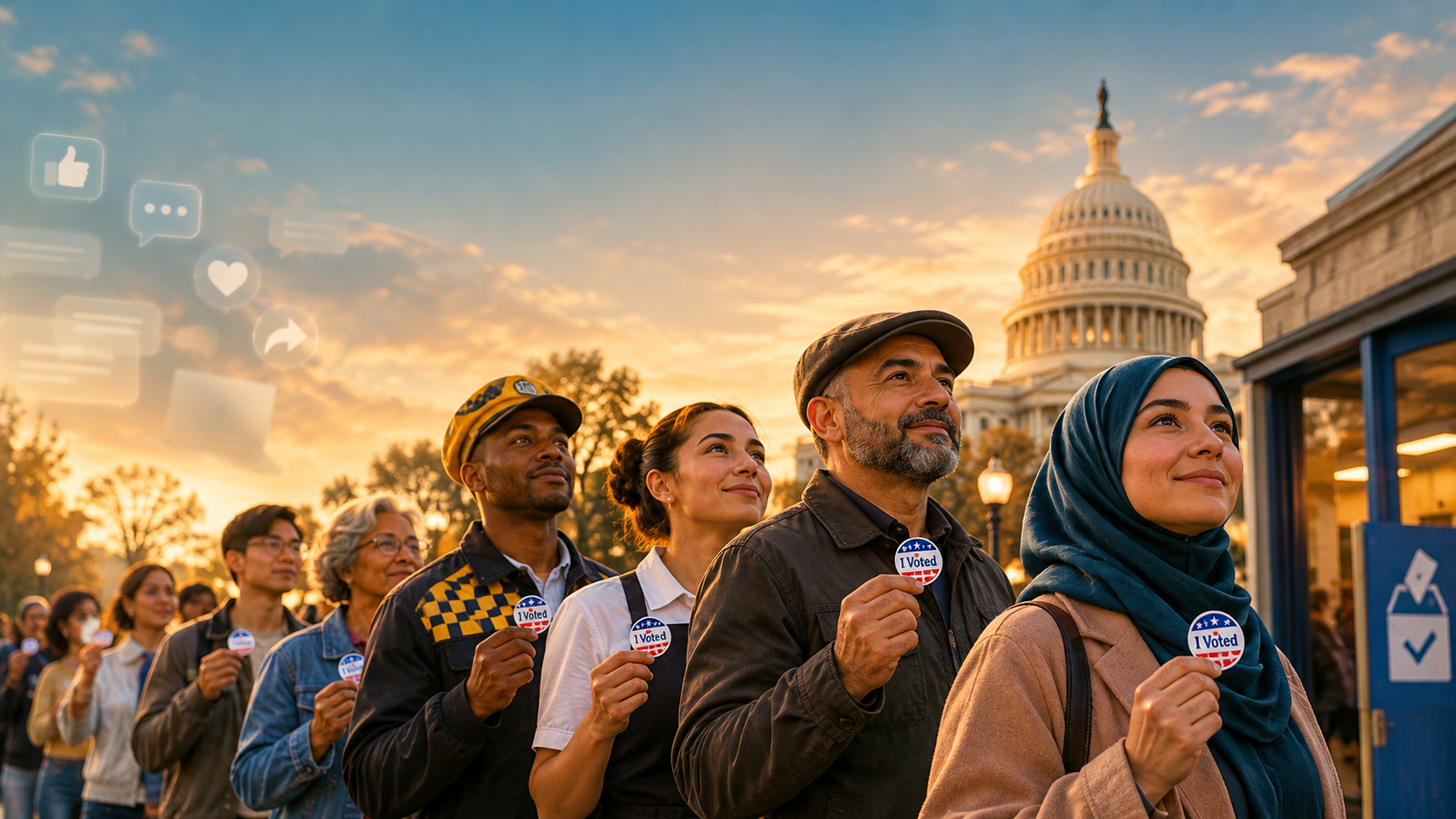
The story of 2026 midterms Muslim political power is not really about one night or one candidate. It is about what happens when people stop shouting from the outside and start walking into the room. On November 3, 2026, Abdul El-Sayed won Michigan’s U.S. Senate race and became the first Muslim ever elected to the Senate. I have been arguing with people about this for days, and the arguments taught me more than the headlines did. So this is my attempt to put it all in one place, the way I would say it to a friend over tea.
What Happened in the 2026 Midterms
Let me start with what is confirmed, because I do not want to build an argument on rumor.
Abdul El-Sayed is 42 years old, born and raised in suburban Detroit to Egyptian immigrant parents. He ran as a progressive Democrat for an open seat, since Senator Gary Peters retired. His opponent was Mike Rogers, a Republican and former chairman of the House Intelligence Committee. Michigan is no easy state for Democrats. Trump carried it by two points in 2024. The Associated Press called the race for El-Sayed, and TIME reported it as a historic first.
He did not do it alone in a bubble either. His coalition included progressives and Arab and Muslim organizers, including people from the 2024 Uncommitted movement. He ran on Medicare for All, higher taxes on the wealthy, and limits on corporate money in politics. He also faced a brutal fight. AIPAC spent tens of millions of dollars against him in the primary and stayed in the fight afterward. In the final weeks, Islamophobic stereotypes were thrown around, and Rogers raised claims about El-Sayed’s family that El-Sayed denies. He still won.
And he was not the only one. According to preliminary counts reported by Muslim Network TV, at least 37 Muslim candidates won or were leading in races across the country. That includes 8 in Congress (one Senate seat and seven House seats), 27 in state legislatures, and 2 in judicial or county races. Ilhan Omar and Rashida Tlaib were re-elected. So were Andre Carson, Aisha Wahab and Lateefah Simon. Adam Hamawy won in New Jersey. Down the ballot, people like Nabeela Syed in Illinois, Ruwa Romman in Georgia and Iman Jodeh in Colorado won state senate seats. Those numbers are preliminary and still need certification, so I will not pretend they are final.
There is a bigger backdrop too. CBS News projected that Democrats won both the House and the Senate, which had been 53 to 47 for Republicans going into the night. That means this was part of a wider wave, and it would be dishonest to say Muslim voters did all of this alone. They did not. But that is exactly the point. Power in a democracy is never one group winning alone. It is a group being part of a coalition large enough to win.
Why 2026 Midterms Muslim Political Power Is Not Just Symbolism
I keep hearing the same objection. It is a nice moment, but nothing changes. Politicians are all the same. The system is rigged.
Here is how I answer it. It gets you a foot in the door and gets the conversation going. At the end of the day, problems are solved by talking. Nobody has ever solved a problem by staying outside the room and complaining about the people inside it.
Think about it practically. Even if the person who gets elected is not the most practicing Muslim in the world, his presence changes who has access. Once someone from your community sits in that chamber, the rest of the community has a way to reach senators who would never have taken their call before. You can bring people from opposing sides to the table. And if you are smart enough, you can use those conversations to get real results.
A senator sits on committees, votes on foreign aid, and has a say in federal appointments. One senator out of one hundred cannot flip policy alone, and I will not pretend otherwise. But one senator can ask the hard question in a hearing, slow down a bill, attach conditions to funding, and force a debate that was never going to happen otherwise. That is leverage. It is small at first, and it grows when people use it.
The Whole World Was Watching
There is another side to this that people miss. The conversation does not only happen in Washington. It happens in the public mind.
I can understand why Muslims living under oppressive governments feel that an election in America makes no difference to them. I get it. But I think it does make a difference. Think about how many people around the world learned something about Islam and Muslims because of this one campaign. It got worldwide attention. Millions of people who have never met a Muslim watched a man from Detroit campaign, debate, get attacked, and win.
That is a platform. Muslims can use it to show the world that Islam is a peaceful religion and that Muslims are people like everyone else, with the same worries about rent, health care and their kids’ schools. You can use that moment to counter the propaganda. Or you can ignore it.
And here is where I get a little blunt. Unless you are just a shill who expects things to happen by themselves, you have to do something. Some people keep living their own comfortable lives, make no effort at all, and then blame the oppressor for oppressing. But it is the oppressor’s job to oppress. That is what oppressors do. It is our job to spread the word of goodness and push back. If you are not even trying, do not be surprised when nothing changes.
Why So Many in the Diaspora Stay on the Sidelines
Now let me be fair, because the people I am criticizing are not stupid, and many of them are not lazy either. The reasons are layered, and I think they come from a few places at once.
First, think about why people leave their home countries. They are looking for a better life. It takes years to settle in the United States or Europe, just to get the paperwork, the job, the rent and the language under control. Politics is the last thing on anyone’s mind when they are busy making ends meet. Most of them never get around to educating themselves on it.
Second, a lot of immigrants are not highly educated. Yes, some are doctors and engineers. But many are table waiters, gas station workers and taxi drivers, and some do not speak the language well. I worked in restaurants for about fifteen years, so I know these people. They work double shifts. Asking them to study congressional subcommittees after midnight is not realistic.
Third, there is a confidence problem. Many people believe American or European politics is far beyond their reach and simply not their cup of tea. Psychologists call this learned helplessness. When you grow up in a system where your voice never changed anything, you carry that belief across the ocean with you, even when the new system actually responds.
And fourth, there is the comfort of the familiar. Many people believe that fixing their home country means ranting on Twitter in their own language about the politicians back home. It feels like participation. It gives you a rush, and a crowd that agrees with you. But it costs nothing, and it changes nothing. Meanwhile, what is happening in their country back home is often a direct result of decisions made in the country where they now live and pay taxes. They reject the elections in their new home without even understanding how a local body election works.
The PTI Fan With Imran Khan on His Profile
I want to tell you about one conversation, because it shows the problem perfectly.
A man was criticizing Abdul El-Sayed online. His profile picture was Imran Khan. He is a die-hard PTI supporter living in the United States. Now, in August 2026, El-Sayed spoke at the Pakistan Association of America in Metro Detroit at an event celebrating Pakistan’s independence anniversary. According to reporting from the Daily Wire, citing the Detroit Free Press, he called for an end to military rule in Pakistan and condemned the jailing of political opponents, including a former prime minister. He said democracy is a precious thing and that it operates on a knife’s edge.
Think about that for a second. A PTI supporter is angry at a man who publicly criticized the military’s grip on Pakistan. That man wants democracy. He is against dictatorship. He is against funding corrupt regimes. So is the candidate he is attacking.
This is what happens when we judge everyone by one question, which is whether they are fighting my exact fight, today, in my exact words. If the answer is not an instant yes, we write them off. But principles matter more than personalities. If more people like Abdul reach the Senate, and it does not matter whether they are Muslim or not, we can push through our votes for senators who build a policy where the U.S. government stops interfering in the politics and internal matters of other countries. Rejecting the whole election and the idea of sending the right candidates to the Senate is silly. I would even say it is stupid.
How Foreign Policy Really Changes
It does not change because of angry posts. It changes when someone on the Senate Foreign Relations Committee or the House Foreign Affairs Committee questions a budget, drafts a bill that conditions military aid, or refuses to vote for a funding package.
Think of it like a river. What you see in Pakistan, Egypt or Gaza is downstream. The decisions about military aid, sanctions and diplomatic cover are upstream, and the upstream is in Washington. People in the diaspora spend all their energy screaming at the downstream water, while they have a vote that could change what is happening at the source. That is the great irony of it.
El-Sayed himself has said that American military assistance should be redirected toward domestic needs like schools and health care. You can agree or disagree with his positions. He also calls Gaza a genocide, and many people, including many Jewish Democrats, were deeply unsettled by his rhetoric. Friction like that is normal. It is the sign of a community that is finally being heard, not ignored.
Learning From Muslim Politicians in the UK and Beyond
This did not start in Michigan. In Britain, Muslims have been walking this road for years. A record number of Muslim MPs, 19 by one count, were elected to the UK Parliament in 2019, and many of them came from Pakistani families. They did not appear in Parliament by accident. They started at the grassroots, as local councillors, community organizers and party volunteers. They learned how the system works, and then they climbed.
That is the real lesson. Western politics is built from the bottom up. School boards, city councils, county judges and state legislatures are very accessible, and that is where the future senators come from. Notice that many of the 2026 winners were exactly those people, state legislators and local officials. If you do not understand how a local election works, you will never understand how a national one does.
So the responsibility falls on people who have already made it through. Politicians like El-Sayed, and the UK MPs, should use their campaigns as classrooms. They should recruit young people, explain voting in the languages that older immigrants speak, and show a taxi driver how a zoning vote or a school budget touches his life. The second generation, who speak both languages fluently and do not carry the same fear, should lead the way. And mosques and community centers can help, as long as they teach civics and not only slogans.
Peace Is Made at the Table
Some people will say that politics is too slow and that only force changes anything. I disagree, and history is on my side. You cannot bring peace by fighting. You bring peace by making peace. After every war in human history, the final decisions were made at a table. The Thirty Years’ War ended with the Peace of Westphalia in 1648. The Vietnam War ended with the Paris Peace Accords in 1973. The fighting moved the pieces on the board, but talking and negotiation settled the terms.
The timing is also in our favor. The Muslim population in the United States is growing. A 2016 Pew Research Center analysis projected that it would double from about 3.3 million in 2015 to more than 8 million by 2050, becoming the country’s second largest religious group by 2040. Add an aging Western population, more access to education, and the internet putting every vote and every budget a few taps away, and it is more possible than ever to push politicians to do the right thing.
But let me be honest about the catch. Numbers alone mean nothing. A growing population is just a crowd until it registers, organizes and shows up. There will be friction. There will be sacrifices of time, energy and money. There will be people who attack you for it. And still, it is the only tool that works.
What You Can Do This Year
If all of this sounds big, start small.
- Register to vote and check your registration before every election, including the small ones.
- Learn who sits on your school board, city council and county commission, and show up at one meeting.
- Write or call your representative about one issue you care about, and follow up.
- Help one older relative or neighbor understand how voting works in a language they are comfortable with.
- Volunteer for a campaign whose principles you share, even for a few hours.
- Stop treating a candidate as useless because he is not fighting your exact personal fight. Look at the principles.
Final Thoughts on 2026 Midterms Muslim Political Power
Abdul El-Sayed’s win does not fix the world. One senator cannot. But it proves something that cynics have been denying for years, which is that the door opens when people knock on it together. The lesson of the 2026 midterms Muslim political power story is simple. Complaining is easy, and voting, organizing and talking are harder. The harder path is the only one that has ever worked.
So the next time you feel the urge to rant on Twitter about the oppressor in your home country, ask yourself a better question. Did I vote? Do I know who my local representative is? Have I done anything upstream? If the answer is no, you know where to start.
Sources
- TIME: Abdul El-Sayed Wins Michigan Senate Race, Making History as First Muslim Senator
- CBS News: 2026 midterm election results
- Muslim Network TV: At least 37 Muslim candidates win or lead races
- The Nation (Pakistan): Muslim candidates make historic gains
- Dawn: Pew Research on US Muslim population to 2050
You might also like Global Undercurrents