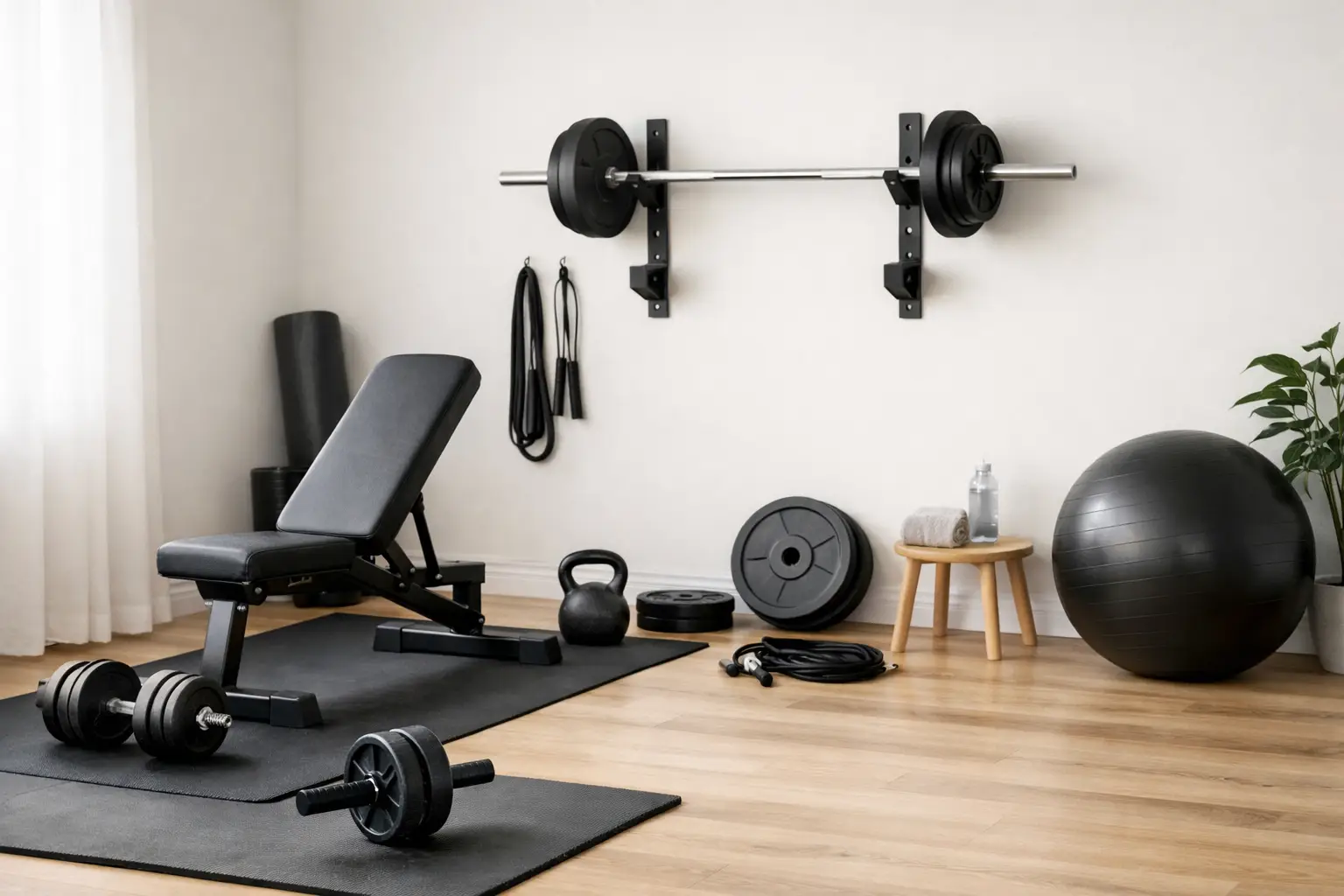
A gym membership is cheap until it becomes a recurring charge for a place you visit twice a month. Building a minimalist home gym on a budget solves a different problem than buying fitness gear: it creates a low-friction training system inside your real schedule. The goal is not to recreate a commercial gym. It is to own a small set of equipment that covers your strength, conditioning, and mobility work without taking over the spare room.
The smartest setup is built around movement patterns, not shopping categories. If a piece of equipment cannot support several exercises, store easily, or fit your current training plan, it is probably not an early purchase.
Start With the Training You Will Actually Do
A compact home gym only works if it matches the way you train. Before buying anything, define your weekly minimum: perhaps three 30-minute strength sessions, two short conditioning blocks, and ten minutes of mobility after work. That is enough to guide every equipment decision.
For most people, the priority movements are squat, hinge, push, pull, carry, and core stability. You do not need six machines to train them. A pair of adjustable dumbbells can handle presses, rows, goblet squats, Romanian deadlifts, lunges, loaded carries, and a surprising amount of accessory work. Add a pull-up option and resistance bands, and the system becomes much more capable.
This is also where honesty saves money. If you dislike high-intensity circuits, do not buy a rowing machine because it photographs well. If you train before your kids wake up, avoid equipment that rattles the floor. The best budget gym is designed around constraints, not aspirational identity.
The Best Minimalist Home Gym Equipment Stack
Think in tiers. Buy the first tier, use it consistently for eight to twelve weeks, then identify the actual bottleneck. That might be available load, pulling volume, cardio capacity, or storage. It is rarely a lack of gadgets.
Tier One: The High-Return Foundation
Start with an exercise mat, a set of loop and tube resistance bands, and either adjustable dumbbells or one to two kettlebells. This package supports a full-body program in a footprint no larger than a closet.
Adjustable dumbbells usually offer the best value for apartment dwellers and beginners because they replace multiple fixed-weight pairs. Their trade-off is speed. Weight changes can interrupt a circuit, and low-cost models may feel bulky or have awkward handles. Kettlebells are simpler, faster to use, and excellent for swings, carries, cleans, and goblet squats, but progressing beyond a single weight can get limiting.
For a tight budget, choose based on your likely program. Dumbbells are more versatile for conventional strength training. Kettlebells are a strong option if you favor conditioning and athletic movement. Bands are not a substitute for progressively heavy loading, but they are an inexpensive way to add rows, presses, face pulls, pulldowns, and warm-up work.
Tier Two: Vertical Pulling and Heavier Work
A sturdy doorway pull-up bar is one of the few low-cost upgrades that materially changes the training menu. Pull-ups, chin-ups, hanging knee raises, and band-assisted variations cover a gap that dumbbells alone do not solve well. Check the frame design, weight rating, and clearance before ordering. Renters should be especially cautious with pressure-mounted models and painted trim.
If your space and budget allow it, the next upgrade is often a flat or adjustable bench. A bench improves pressing angles, supported rows, split squats, step-ups, and hip thrusts. It is useful, but not mandatory. A floor press and single-leg work can carry a program for a long time.
A heavier kettlebell or additional dumbbell load is often a better purchase than a bench for people who have already outgrown their current resistance. Progressive overload remains the decision rule. A polished setup that never gets heavier will stall faster than a plain setup with a clear loading path.
Tier Three: Only Buy for a Proven Need
Cardio machines, cable systems, squat racks, and specialty bars are not bad purchases. They are later-stage purchases. A folding treadmill may be worth it for someone who needs indoor walking during winter or while supervising children. A rack may be the right move for a serious barbell lifter with a garage and a long-term plan.
The mistake is buying these items before a consistent practice exists. Large equipment has a hidden cost: floor space becomes psychological pressure. When the home gym feels cluttered, it stops feeling like an invitation to train.
Build the Space Like a Small Operating System
The hardware matters, but the setup determines whether it gets used on a Wednesday at 6:40 p.m. Reserve a defined zone, even if it is only a six-by-eight-foot section of a bedroom, office, or garage. Do not spread equipment throughout the house. A scattered setup creates setup friction and visual clutter.
Use a simple storage rule: the floor is for training, not permanent storage. A vertical dumbbell stand, wall hooks for bands, and a compact bin for smaller accessories keep the area functional. In a multipurpose room, a rolling cart or lidded storage bench can make the setup disappear after a session.
Flooring deserves more attention than most buyers give it. Thin exercise mats are fine for bodyweight work, but they will not protect hardwood from dropped weights or stabilize a loaded stance. Dense rubber tiles or a rubber roll are a better investment in a garage or dedicated corner. If noise is a concern, use controlled tempo work, avoid dropping weights, and train with dumbbells or bands instead of ballistic lifts.
Lighting and temperature are also operational details. A dark, cold garage may be technically available but practically unused for half the year. A small fan, brighter bulb, and a visible timer can do more for adherence than another accessory.
Budget Rules That Prevent Expensive Mistakes
Set a total number before you browse. A practical starting range is $200 to $500, depending on whether adjustable dumbbells are part of the plan. That budget can create a legitimate training environment, not a temporary compromise.
Use a 48-hour waiting rule for nonessential equipment. If an item still solves a documented training problem after two days, it may be worth buying. If the reason is a social media workout clip, wait longer.
Used equipment is often the strongest value play. Cast-iron kettlebells, plates, simple benches, and racks can last for years. Inspect for cracked welds, damaged adjustment pins, severe rust, unstable frames, and missing hardware. Avoid used resistance bands with visible splitting and adjustable dumbbells with unreliable locking mechanisms. Savings are not savings if the equipment is unsafe.
Do not underestimate shipping, assembly, and returns. A low advertised price can become a poor deal once freight charges and a difficult return policy enter the picture. Measure both the equipment and the path it must travel through. Many home-gym regrets begin with a box that cannot clear a stairwell.
Use a Simple Program Before Expanding the Setup
Equipment does not create results. Repeated, trackable sessions do. With dumbbells, bands, and a pull-up bar, you can run two alternating full-body workouts three days per week.
Workout A can center on goblet squats, dumbbell floor presses, one-arm rows, Romanian deadlifts, and a plank variation. Workout B can use reverse lunges, standing overhead presses, pull-ups or band pulldowns, hip bridges, and loaded carries. Keep most sets in a moderate rep range, record the weight and reps, and add load or repetitions when the work becomes manageable with solid form.
This is deliberately unglamorous. It also works. Minimalist training makes progress visible because there are fewer variables to hide behind. If you miss sessions, solve the schedule. If you stop progressing, add resistance, reps, or another set. If the plan is boring, change the exercise variation before buying a machine.
Let Consistency Earn the Next Purchase
The real advantage of a home gym is not that it gives you unlimited exercise options. It removes the small negotiations that make exercise easy to postpone: the commute, the packed bag, the crowded floor, and the question of whether a 25-minute session is worth leaving home for.
Build the smallest system that makes training easier this month. Then let eight weeks of actual use tell you what deserves more space, more money, and more attention.