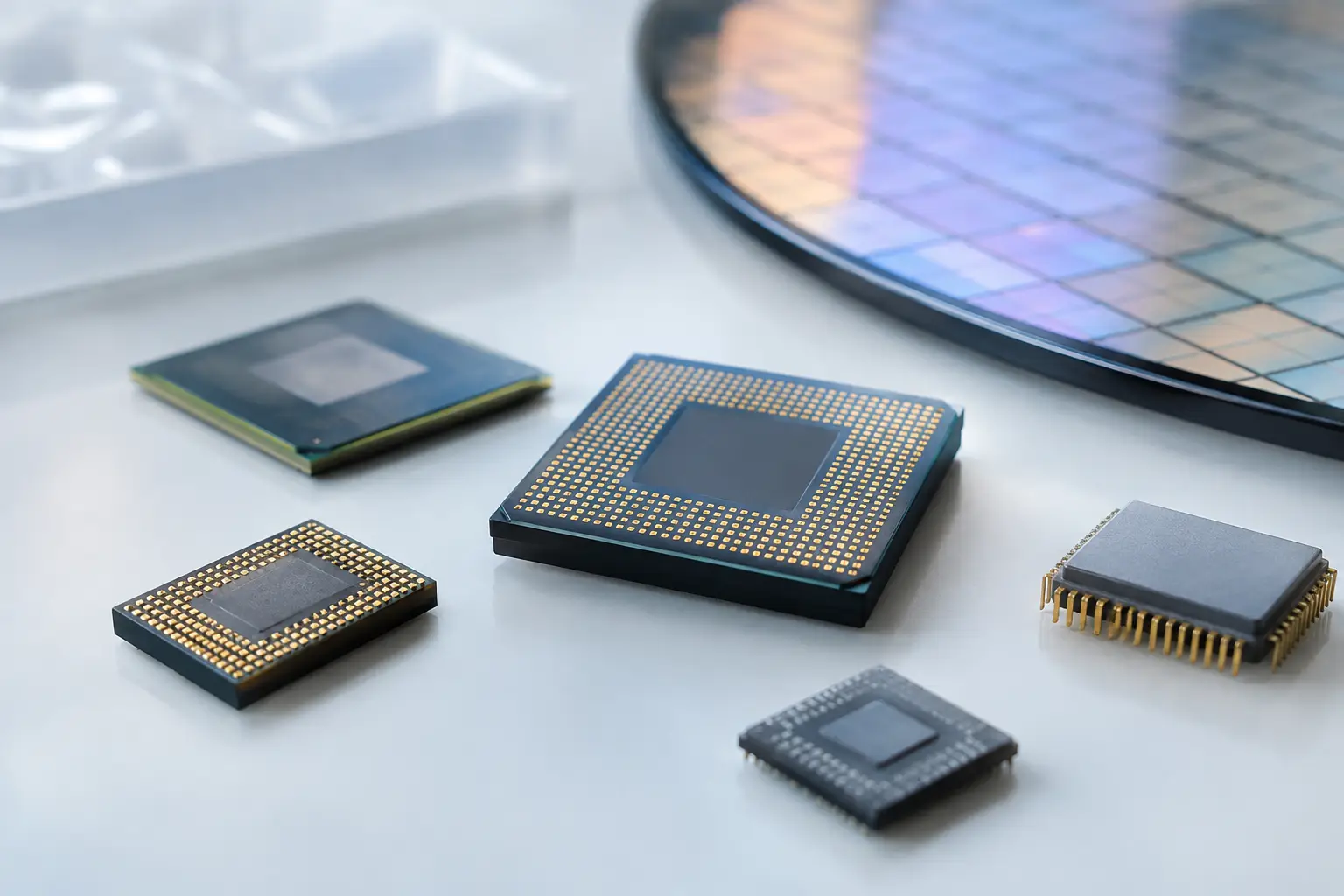
A new laptop can look almost identical to the one it replaces, yet be harder to repair, more dependent on a distant factory, and far more capable at running artificial intelligence locally. The difference is increasingly not the visible machine. It is the way its computing components are assembled. Semiconductor packaging trends 2027 will affect the price, reliability, energy use, and repairability of the devices that now carry work, school, banking, entertainment, and family coordination.
For most people, packaging sounds like an industrial detail. It is not. Packaging is the physical architecture around and between the tiny components that perform computation. As chipmakers run into limits on making individual processors smaller and faster, they are putting more pieces together in tighter, smarter arrangements. That shift has consequences well beyond a factory floor.
Semiconductor Packaging Trends 2027: The Real Shift
The headline is not one miracle chip. It is a move from a single large piece of silicon toward systems made from several specialized pieces, called chiplets, connected inside one package. One section may handle general computing, another graphics, another memory, and another artificial intelligence tasks. The package becomes the place where those parts cooperate.
This approach can improve performance without demanding that every function be manufactured using the newest, most expensive process. It can also let manufacturers reuse proven components instead of redesigning an entire processor each time. In theory, that should make innovation more practical.
In practice, it creates a new concentration of risk. Connecting chiplets at very high speeds requires advanced materials, precision assembly, and rigorous testing. A failure in one part can spoil a complete package containing several valuable parts. So while chiplet designs may reduce dependence on one kind of fabrication capacity, they increase dependence on a narrower group of advanced packaging facilities.
For households and small businesses, this is why a supply disruption can still affect the availability and cost of ordinary equipment long after the original shortage makes headlines. Complexity does not disappear. It moves.
More Computing, Closer Together
The most consequential packaging change is 2.5D and 3D integration. In 2.5D designs, multiple components sit side by side on a connecting layer. In 3D designs, components are stacked vertically. Both shorten the distance data has to travel.
That matters because moving data consumes energy. A system can have a powerful processor but still waste time and battery life shuttling information between memory and compute units. Bringing those pieces closer can improve speed and reduce power used per task, particularly for artificial intelligence workloads, graphics, and data-heavy professional software.
The trade-off is heat. Stack more active components into a compact area and cooling becomes harder. This is not a small engineering footnote. Heat affects sustained performance, battery health, fan noise, device thickness, and long-term reliability. Expect manufacturers to spend as much effort on thermal design, materials, and power management as on raw processing claims.
That should temper the usual upgrade reflex. A machine advertised as having local AI capability may be genuinely useful for transcription, photo sorting, language assistance, or private document search. But capability depends on memory, cooling, software support, and the kind of work being done. The label alone says little about whether it will help someone finishing a proposal at the kitchen table while a child streams a class nearby.
Memory Is Becoming the Bottleneck
Artificial intelligence has made memory the center of the packaging conversation. Large models need huge amounts of data moved quickly. High-bandwidth memory, often stacked close to computing components, is one answer. It is particularly important in servers that train and run AI systems.
By 2027, that demand is likely to keep pulling advanced packaging capacity toward data centers. This may have an indirect but real effect on consumer and business markets. When a small number of suppliers prioritize high-margin AI infrastructure, other categories can face tighter supply, delayed product cycles, or higher component prices.
There is a second implication for remote workers. More work may happen locally, on the device, rather than being sent to a cloud service. That can reduce latency and improve privacy, especially where connections are inconsistent or expensive. Across Latin America, where service quality can change block by block, local processing is not merely a convenience. It can make a tool usable during an unreliable connection.
Still, local AI is not automatically more private or more sustainable. The software may keep logs, synchronize data, or rely on cloud checks. A more powerful device may also be replaced sooner if memory is fixed and inadequate. Buyers should look past claims about AI and ask a simpler question: can this machine handle the work I actually repeat every week, for several years?
The Repairability Problem Gets Physical
Advanced packaging often leads to tighter integration. Memory, processors, and other functions may be placed into a compact package or mounted in ways that make replacement impractical. This can deliver speed and lower power use, but it can also turn a failure in one area into a replacement of the entire board or device.
That is a poor bargain for many families and independent professionals. A repairable machine is not just an environmental preference. It is a continuity plan. When a computer fails before a client deadline, the key question is not whether a newer model has better benchmark results. It is whether the current tool can be repaired locally, whether data is backed up, and whether work can continue tomorrow.
The answer varies by product category. In a tightly constrained mobile device, integration can be a reasonable engineering compromise. In a desktop workstation, home server, or business laptop, permanently fixing every major component in place deserves more skepticism. The market should not treat thinness as a universal good.
Packaging innovation may therefore sharpen the divide between devices designed as durable tools and devices designed as sealed appliances. Consumers cannot control the architecture inside every product. They can favor longer support periods, accessible service documentation, available replacement parts, and storage options that match their actual needs.
Supply Chains Will Be Less Simple, Not More Local
Governments in the United States, Europe, Japan, South Korea, China, and elsewhere are investing heavily in domestic manufacturing. That can improve resilience, but advanced packaging is not something a country adds overnight by opening one building. It relies on equipment, chemicals, substrates, testing capacity, engineering talent, and trusted relationships across many firms.
The likely 2027 picture is regionalization rather than full self-sufficiency. North America may gain more capacity. Asia will remain essential. Mexico and other Latin American economies may gain opportunities in assembly, testing, logistics, electronics manufacturing, and specialized services, though those gains will not be automatic. Infrastructure, energy reliability, workforce development, and predictable rules matter more than announcements.
For organizations, the practical lesson is to stop treating technology procurement as a once-a-year shopping task. Critical equipment needs a continuity plan: standardized models where possible, a realistic replacement cycle, clear data backups, and at least one workable fallback for essential work. This is boring operational discipline, which is precisely why it holds up when markets become strange.
What to Watch Without Becoming a Hardware Analyst
You do not need to follow every packaging technique or factory investment. Watch the outcomes that reach ordinary life. Are devices becoming more useful without becoming disposable? Is local computing reducing dependence on subscriptions and unstable connections? Are repairs available at a fair cost? Are supply disruptions still forcing people to overpay for basic tools?
The best signal is often not a technical announcement. It is whether a three-year-old device remains capable, supported, and fixable. Packaging advances should make technology more efficient and more capable. If they instead make essential tools sealed, short-lived, and harder to obtain, then the industry has solved the wrong problem.
As 2027 approaches, treat the machinery behind digital life as part of household planning, not distant industrial trivia. The most useful technology is still the kind that stays dependable when work is urgent, the connection drops, and real life refuses to wait.