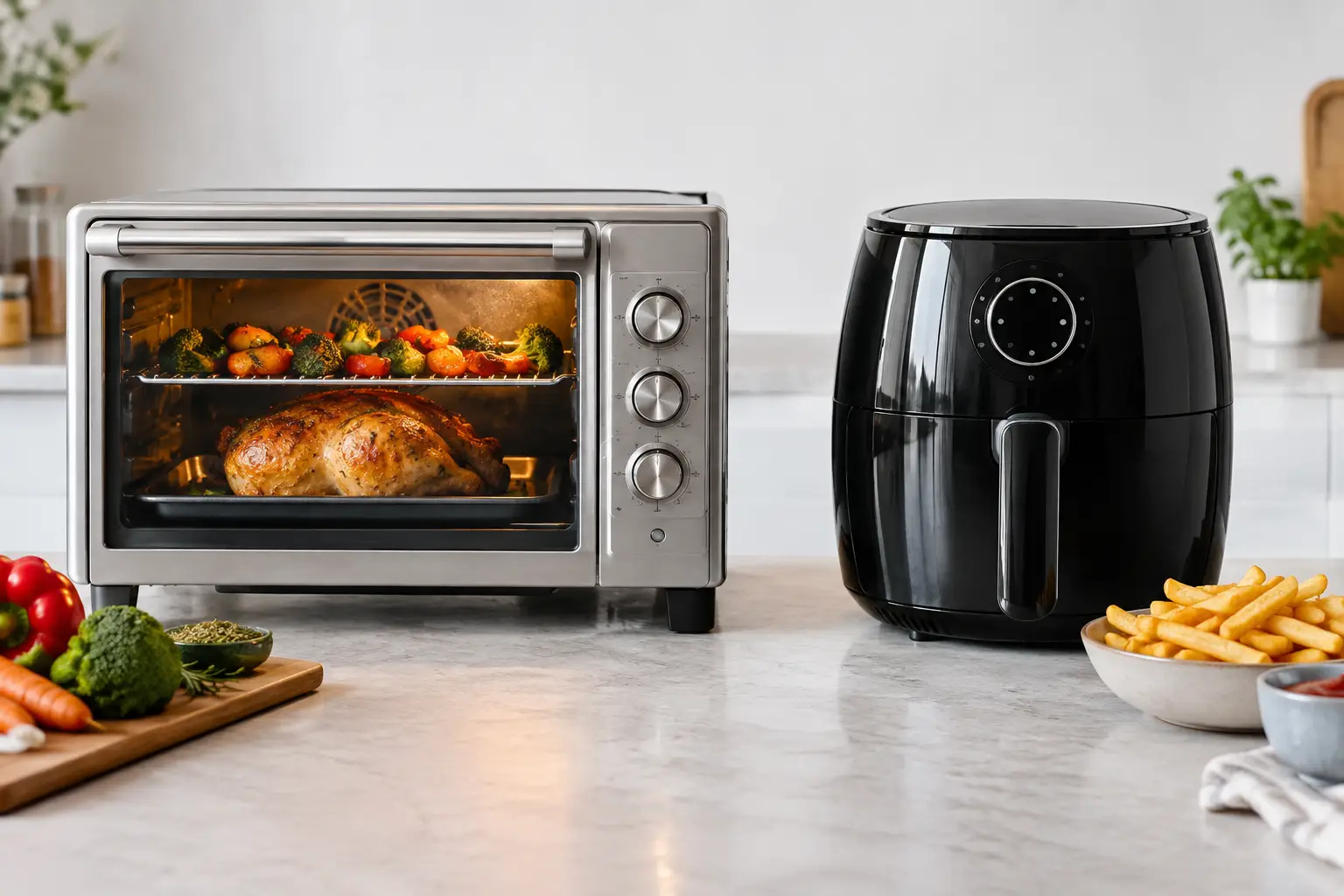
A convection oven versus air fryer decision is not really about which machine makes food crispier. Both circulate hot air. The useful question is which one removes friction from the meals you actually cook on weeknights, during batch-prep sessions, and when people are waiting to eat.
For a one- or two-person household that wants fast, crisp portions, an air fryer can earn its counter space quickly. For families, frequent entertainers, and serious home cooks who need to roast, bake, and cook multiple components at once, a convection oven is usually the stronger operating system. The difference comes down to airflow intensity, usable capacity, preheat time, and how much manual handling your workflow can tolerate.
Convection Oven Versus Air Fryer: The Real Difference
A convection oven uses a fan to move hot air around the cavity, reducing cool spots and speeding up cooking compared with a conventional oven. The fan is typically positioned at the back, and the larger cavity gives food room to cook across sheet pans, roasting pans, and racks.
An air fryer is a compact, high-intensity convection appliance. Its smaller chamber and concentrated fan create faster airflow around food, especially in a perforated basket. That is why an air fryer can brown frozen fries, chicken wings, and breaded cutlets aggressively with little oil. It is also why a crowded basket produces disappointing results. Airflow is the entire mechanism. Block it, and you have a small oven with poor circulation.
This distinction matters more than marketing labels. Many countertop toaster ovens now include an air-fry setting, but their performance varies. A large oven-style unit can handle more food, while a drawer-style air fryer often delivers more forceful browning per square inch. Neither is universally better. They are optimized for different loads.
Speed Favors the Air Fryer, but Only for Small Batches
Air fryers usually reach cooking temperature faster because they are heating a small chamber. For a quick lunch, that can eliminate the hesitation that comes with turning on a full-size oven. Salmon portions, vegetables, reheated pizza, chickpeas, and frozen snacks often cook 20 to 30 percent faster than their conventional-oven instructions suggest.
The speed advantage disappears when the batch grows. A four-quart air fryer may hold two chicken breasts comfortably, but feeding four people can require two rounds. At that point, the total cook time includes shaking, unloading, holding the first batch, and resetting the second. A convection oven can roast a full tray of vegetables or bake eight chicken thighs at once, even if it takes a few minutes longer to preheat.
Use this simple capacity test before buying: picture your most common protein-and-vegetable dinner. If it fits in one loose layer in an air-fryer basket, the air fryer is likely efficient. If you would need to stack, crowd, or cook in shifts, the convection oven will be faster in practice.
Texture Depends on Airflow, Food Shape, and Space
The air fryer wins its reputation on texture for a reason. Its compact chamber exposes more of the food surface to fast-moving heat. That makes it exceptional for foods with lots of exposed edges: wings, Brussels sprouts, cubed potatoes, breaded shrimp, tofu, and leftovers that need their crust restored.
A convection oven creates excellent browning too, particularly when food is placed on a wire rack over a sheet pan or spread across a preheated metal pan. But it has more empty air to heat and less concentrated airflow. It is better at controlled roasting, where you want caramelization without turning every exterior surface into a hard crust.
This is a key trade-off for advanced home cooks. An air fryer is often superior for finishing and reheating. A convection oven is more versatile for the full cooking sequence. Roast chicken, for example, benefits from the oven’s space and steady heat. Crisping a few leftover chicken pieces the next day is an air-fryer job.
Baking introduces another constraint. Strong airflow can distort delicate batters, dry the surface of small pastries, or send parchment paper toward the heating element if it is not weighted down by food. A convection oven with an adjustable fan or a standard bake mode is safer for cakes, custards, soufflés, and large loaves. Air fryers can bake, but that does not make them a replacement for an oven if baking is part of your regular system.
Capacity Is the Cost Most Buyers Underestimate
Air fryer capacity is advertised in quarts, which is not the number that matters. Basket footprint matters. A tall, deep basket may claim six quarts but still cook poorly if a family-sized portion has to be piled up. Two-basket models solve some workflow problems by allowing separate temperatures, but they still take considerable counter width and add another basket to wash.
Convection ovens scale better because they accept standard cookware. Half-sheet pans, quarter-sheet pans, roasting pans, Dutch ovens, and oven-safe skillets all fit into an established kitchen workflow. You can cook a tray of vegetables while a casserole bakes, or use two racks for a larger production run. That flexibility is valuable for meal prep, dinner parties, and anyone who prefers cooking once and eating strategically through the week.
A countertop convection oven is a middle path, but measure carefully. Many compact units cannot fit a standard quarter-sheet pan, and some have limited clearance for tall dishes. Check interior dimensions, not just exterior width. Also consider door clearance, venting space, and whether the unit can stay on the counter without making your primary prep zone unusable.
Energy Use Is About the Cooking Task, Not the Appliance Label
For a small meal, an air fryer generally uses less energy than a full-size oven because it heats less air and runs for less time. That is meaningful if you regularly cook one or two portions or reheat leftovers. It also reduces heat dumped into the kitchen, which matters in warm climates and small apartments.
For larger loads, a convection oven becomes the more rational choice. Running an air fryer three times to produce dinner wastes the advantage of its small cavity. One full oven cycle can handle the same food with fewer interruptions and better scheduling.
Think in terms of load factor. Use the smallest appliance that can cook the entire meal in one efficient pass without crowding. That rule produces better food and makes more sense than treating either appliance as inherently economical.
Cleanup and Reliability Change Daily Use
Drawer-style air fryers are convenient until the basket coating starts to wear or grease accumulates in the heating area. Choose a model with a removable crisper plate, dishwasher-safe parts, and an accessible interior. Avoid metal utensils and harsh scrubbers on nonstick baskets. A silicone liner can reduce mess, but a solid liner also reduces airflow, so use it for sticky foods rather than everything.
Convection ovens create a different cleanup profile. Sheet pans and racks are familiar, durable, and easy to replace. The oven interior needs periodic attention, especially when roasting fatty food, but the cookware can be lined with foil or parchment when appropriate. For many experienced cooks, that predictability is preferable to scrubbing a basket after every high-fat meal.
Reliability also favors simplicity. A standard full-size convection oven has fewer specialized parts than a digital air fryer with a touch panel, basket latch, and multiple sensors. That does not mean air fryers are fragile, but it does mean the best purchase is rarely the one with the longest menu list. Prioritize temperature range, usable basket area, cleaning access, and build quality over preset buttons.
Build the Right Kitchen System
Choose an air fryer if your kitchen needs a fast finishing station. It is ideal for busy professionals, apartment kitchens, parents making quick sides, and anyone who routinely cooks small batches of crisp food. A single-basket model is usually enough for one or two people. Dual baskets make sense only when you regularly need separate foods at separate temperatures.
Choose a convection oven if you cook for three or more people, batch-prep, bake, roast whole proteins, or want one appliance to support several techniques. If your main oven already has reliable convection, you may not need a separate countertop convection unit at all. Put that budget into heavy sheet pans, wire racks, an instant-read thermometer, and containers that make leftovers easy to use.
The strongest setup for a high-output home kitchen is often both: a convection oven for volume and an air fryer for speed, finishing, and recovery meals. But buy the second appliance only after identifying a repeatable bottleneck. If your problem is soggy leftovers, the air fryer solves it. If your problem is getting dinner for five onto the table at the same time, it does not.
Treat the purchase as a workflow decision, not a countertop trend. The appliance that matches your portion size, cookware, and cooking rhythm will get used often enough to justify the space it occupies.