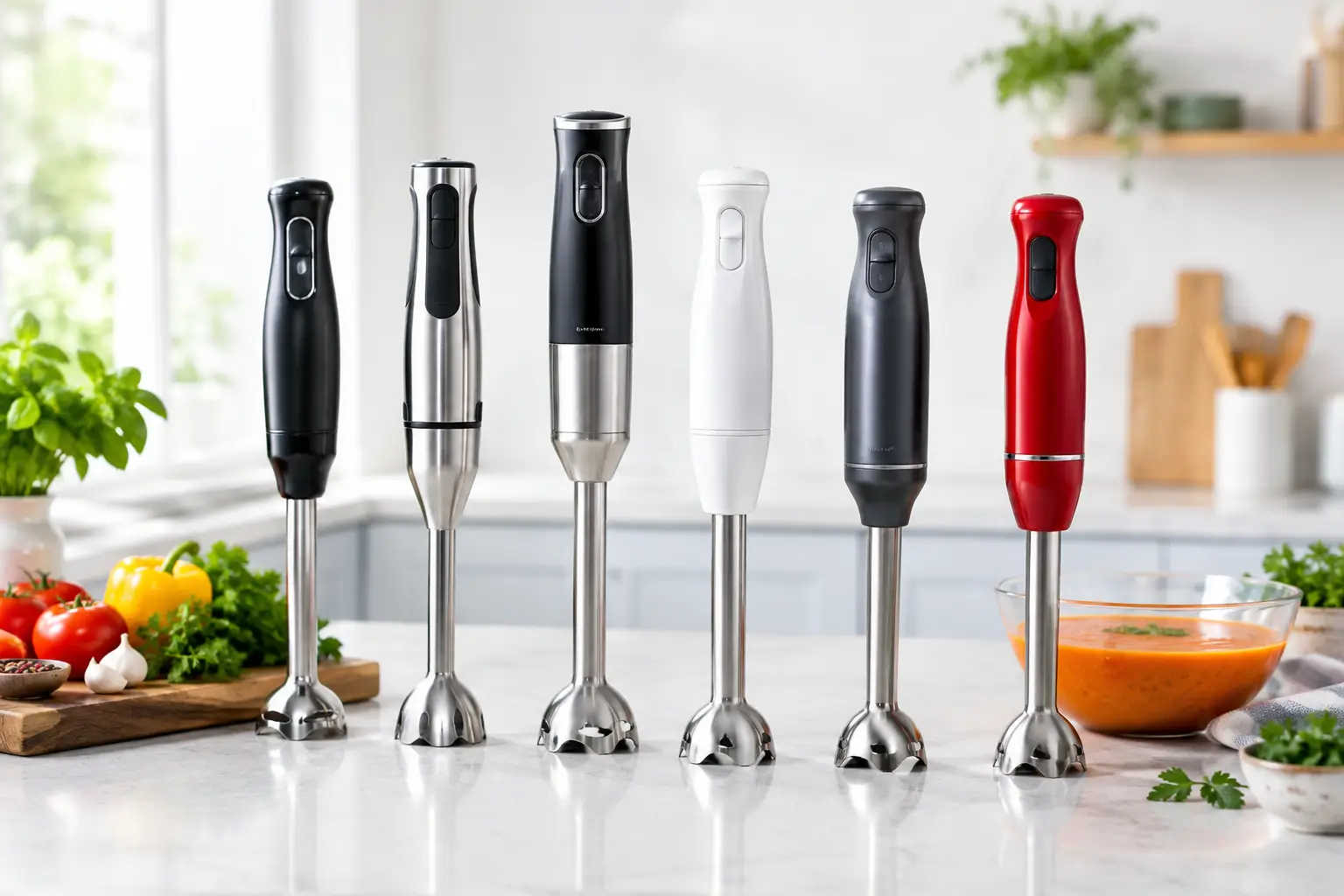
A countertop blender is excellent at one job: making a large, uniform batch. The best immersion blenders solve a different operational problem. They let you puree directly in the Dutch oven, emulsify a small vinaigrette without dirtying a pitcher, and recover a broken sauce before dinner becomes a project.
For serious home cooks, this is not a novelty appliance. It is a high-frequency tool that earns its drawer space through speed, cleanup, and control. The right pick depends less on maximum wattage than on what you make repeatedly, how much counter storage you have, and whether a whisk, mini chopper, or cordless setup actually fits your workflow.
How We Evaluated the Best Immersion Blenders
An immersion blender should feel stable in a pot, not torque sideways when it hits a dense vegetable. It should create a smooth puree without leaving a ring of unblended food around the edges. The details that affect those outcomes are the bell shape around the blade, the length of the shaft, the usable speed range, and how comfortably the handle works one-handed.
Power matters, especially for fibrous soups, hummus, nut-based sauces, and frozen fruit. But a huge motor paired with a single aggressive speed can splatter hot food and overwork delicate emulsions. Variable speed is usually the more valuable feature. So is a removable stainless-steel blending arm that can go straight into the dishwasher or sink.
Attachments deserve skepticism. A beaker is useful. A whisk can replace a hand mixer for whipped cream, mayonnaise, and small batter jobs. A chopper bowl is useful only if you regularly process aromatics, herbs, or nuts in small quantities. Do not pay a major premium for a box of parts that will live untouched behind your sheet pans.
1. Breville Control Grip: Best Overall
The Breville Control Grip is the strongest all-around choice for cooks who want one immersion blender to handle soups, sauces, and occasional prep attachments. Its design focuses on practical control: the handle is comfortable under sustained use, the trigger-style speed adjustment is intuitive, and the bell shape is built to reduce suction against the bottom of a pan.
That last point sounds minor until you are blending a thick cauliflower soup in a heavy pot. Less suction means less arm fatigue and fewer awkward stops to reposition the blender. The included processing bowl and whisk also make the package more credible than most attachment bundles.
The trade-off is size. It is not the lightest tool in this group, and it costs more than a basic stick blender. Buy it if you want a durable primary machine rather than the cheapest way to puree soup twice a month.
2. Braun MultiQuick 9: Best for Heavy Prep
Braun’s MultiQuick 9 line is built for the cook who pushes an immersion blender beyond soup. It has serious power, a broad speed range, and a system of attachments that can handle chopping, whisking, mashing, and food-processing tasks with more confidence than typical add-ons.
Its most useful advantage is how it manages hard or dense ingredients. For roasted root vegetable soups, pesto, bean dips, and large batches of sauce, it works quickly without demanding the stop-start rhythm common with lighter models. The active blade design also helps pull ingredients into the cutting zone.
This is the better choice for a household that cooks from raw ingredients several nights a week. It is also more machine than a simple sauce-and-soup user needs. The accessory set requires cabinet space, so consider it a compact prep system, not a minimalist utensil.
3. All-Clad Stainless Steel Immersion Blender: Best for Minimalists
The All-Clad stainless steel immersion blender makes sense when you value a straightforward, premium-feeling tool over an accessory ecosystem. It is designed around the core job: direct blending in pots, tall containers, and saucepans, with a substantial build that feels at home beside serious cookware.
This is a good match for cooks making pan sauces, pureed soups, and quick dressings who already own a food processor and stand mixer. There is less temptation to manage specialty attachments because the tool does not pretend to replace every small appliance.
The limitation is obvious: fewer extras mean fewer ways to justify the cost if you want chopping or whisking capacity. Still, a dedicated blender that is easy to grab and easy to clean often gets more use than an elaborate kit.
4. KitchenAid Cordless Variable Speed: Best Cordless Option
A cordless immersion blender fixes a real friction point. You can move from the stove to the island, blend at an outdoor cooking station, or work in a cramped kitchen without routing a cord around a hot burner. KitchenAid’s cordless variable-speed model is the practical pick for that use case because it is compact, familiar, and supported by a broader cordless tool platform.
It is especially good for finishing tasks: smoothing a soup, frothing a small sauce, making whipped cream, or blending a protein shake. The variable-speed trigger gives it more finesse than many battery-powered competitors.
Battery life is the unavoidable compromise. It is not the tool to choose for repeated batches in a long meal-prep session, and the battery needs a charging routine. If your immersion blender stays near the stove and handles dense food often, a corded model remains the smarter system.
5. Vitamix Immersion Blender: Best for Power-First Cooks
Vitamix brings its performance reputation to a clean, powerful immersion format. This is for cooks who routinely make thicker soups, creamy vegetable purees, and sauces where a weak motor creates extra work. It feels substantial, and its variable-speed control allows you to start gently before increasing force.
The appeal is directness. You get a powerful motor, a long blending arm, and a strong focus on the core blending task. It is also a sensible option for anyone who likes the Vitamix approach to durable, high-output kitchen gear but does not need another countertop base.
It has fewer bundled capabilities than the Braun. That is not necessarily a flaw. If your kitchen is already organized around dedicated tools, the Vitamix avoids duplicate attachments and does the main job exceptionally well.
6. Cuisinart Smart Stick: Best Value
The Cuisinart Smart Stick line remains a sensible value play because it covers routine blending without forcing a premium purchase. For tomato soup, salad dressing, pancake batter, and a quick smoothie, it gives most households the functionality they will actually use.
Expect fewer refinements. It may vibrate more, offer less control under a heavy load, and take longer to turn a fibrous soup completely smooth. That does not make it a poor tool. It makes it the right tool for lighter duty and a lower budget.
Choose Cuisinart when the goal is to eliminate blender-jar cleanup, not to build a high-performance prep station. It is also a sensible second immersion blender for a vacation home or small apartment kitchen.
7. Bamix SwissLine: Best Long-Term Specialist
Bamix occupies a distinct category. Its Swiss-made build, compact motor unit, and long-lived reputation appeal to people who would rather buy one specialized tool and keep it for years. The accessory approach is different from large-bowl systems, with small multipurpose processors and discs designed for specific jobs.
It excels at sauces, small portions, dressings, whipped preparations, and finely textured work. The compact footprint is a major advantage in a kitchen where every drawer has a job.
The price can be hard to justify for an occasional user, and its system can feel less immediately intuitive than a mainstream all-in-one bundle. It is a strong fit for design-conscious, frequent cooks who prioritize longevity and small-batch precision.
Build a Better Blending Workflow
The best results come from technique as much as hardware. Use a vessel that is deep enough to keep the blade bell submerged. Start at low speed, especially with hot liquid, then move the blender slowly through the pot while tilting it slightly to circulate food toward the blade. Do not lift the head while it is running unless you enjoy cleaning soup from the backsplash.
For silkier soups, cook vegetables until they crush easily against the side of the pot before blending. An immersion blender can pulverize soft food quickly, but it cannot fully compensate for undercooked carrots or woody squash. For mayonnaise and vinaigrettes, use a narrow beaker and keep the blade over the egg yolk or emulsifier at the start.
Your storage setup matters too. Keep the blender near the cookware used for soups and sauces, not buried with pastry tools. A high-frequency kitchen tool should be reachable in one motion. That small placement decision is often the difference between using it three times a week and forgetting it exists.
Pick the model that removes the most friction from the meals you already cook. A fast, controlled blend in the pot is not just cleaner than transferring hot food to a countertop blender. It keeps the momentum of cooking intact.