A chef’s knife that feels wrong rarely fails because it is dull or cheap. More often, it is the wrong length for the way you actually prep food. Which chef knife length matters is not a trivia question for knife collectors. It determines board clearance, control, fatigue, and whether your most-used tool speeds up dinner or creates small daily friction.
The default answer is an 8-inch chef’s knife. For many home kitchens, that answer is correct. But it becomes lazy advice when it ignores the size of your cutting board, your hand size, the ingredients you prep, and the storage system around your workstation. A knife should fit the workflow, not an imaginary professional kitchen.
Which Chef Knife Length Matters for Your Setup?
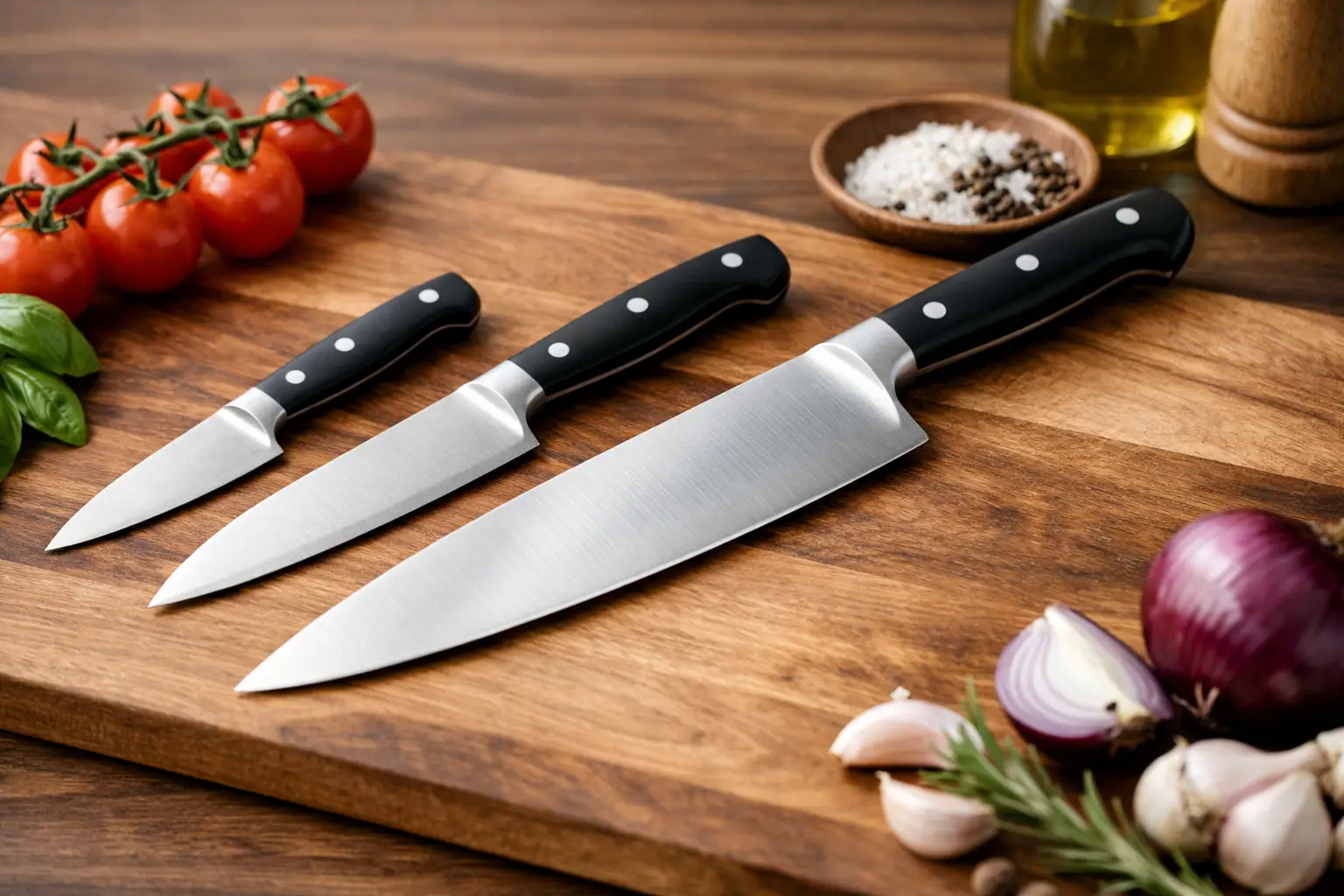
Blade length is measured from the heel, where the blade meets the handle, to the tip. A 6-inch chef’s knife is compact and quick. An 8-inch knife is the working standard. A 10-inch knife offers reach and volume capacity, but requires more board space and more deliberate control.
The key distinction is not whether a longer knife is “better.” It is whether its usable cutting edge matches your prep volume. If you regularly break down large squash, cabbage, watermelon, or family-size piles of onions, a longer blade reduces the number of cuts and gives you a more stable slicing path. If your normal task is trimming herbs, cutting one onion, and prepping vegetables for two, excess length can make the knife feel like equipment you have to manage rather than an extension of your hand.
A useful test: place the knife diagonally on your primary cutting board. If the handle or tip constantly crowds the board’s edge during a rocking cut, the knife-board pairing is inefficient. This is why a well-designed 8-inch knife can feel awkward on a small board, while a 10-inch knife feels perfectly rational on a large, stable end-grain board.
The 6-Inch Chef’s Knife: Fast, Precise, Limited
A 6-inch chef’s knife makes sense for cooks who prioritize control over capacity. It is especially practical in apartment kitchens, compact galley layouts, and households where the cutting board comes out only for short prep sessions. Smaller hands often find the shorter blade easier to guide, though hand size alone should not decide the purchase.
Its strength is low-friction prep: garlic, shallots, herbs, small fruit, citrus, mushrooms, and individual portions of protein. It also excels when your knife technique is mostly forward-and-down slicing rather than broad rocking motions. The shorter profile makes it less intimidating for a newer cook and easier to use in a crowded sink-to-stove workflow.
The limitation appears when ingredients get wide or dense. A 6-inch blade can split an onion, but it offers less runway for clean slices through a large onion or a head of cabbage. It may also force a sawing action on products that a longer knife would dispatch in one confident stroke. That is not just slower. It can compromise consistency when you are trying to cook vegetables evenly.
Think of the 6-inch model as a high-control daily driver, not a scaled-down 8-inch knife that does everything equally well.
Why the 8-Inch Knife Is Still the Best Default
The 8-inch chef’s knife earns its reputation because it covers the most workflows without demanding a commercial-size station. It has enough blade to handle a substantial onion, a bunch of greens, a whole chicken, or a sheet-pan volume of vegetables. At the same time, it remains maneuverable enough for weekday cooking.
For an advanced home cook, this is usually the highest-return first purchase. The length supports a proper pinch grip, gives the tip enough reach for detailed work, and provides enough heel for firm cuts through carrots, sweet potatoes, and dense herbs. It is also long enough to move chopped ingredients from board to pan efficiently, using the broad blade as a transfer tool.
There is a caveat: not all 8-inch knives feel alike. Blade height, curvature, weight distribution, handle angle, and thickness behind the edge can change the experience more than an inch or two of nominal length. A tall 8-inch German-style knife with a pronounced belly will favor rocking cuts and heavier prep. A slimmer Japanese-style gyuto of the same length may feel quicker and more precise, with less tolerance for twisting through hard foods.
That means the right question is not simply, “Should I buy an 8-inch knife?” It is, “Does this 8-inch knife support my cutting motion and ingredient mix?” For most people building a deliberate kitchen system, the answer remains yes, but the profile deserves as much attention as the length.
When a 10-Inch Chef’s Knife Is the Smarter Tool
A 10-inch chef’s knife is not overkill when the workload supports it. If you cook for four or more people several nights a week, batch-prep ingredients, preserve seasonal produce, or host regularly, the extra length changes the pace of prep. You can process more food with fewer resets, make longer slicing strokes, and keep a cleaner rhythm through large vegetables and proteins.
The advantage is especially clear with long cuts. Slicing a roast, portioning large fish, shredding cabbage, and cutting wide produce all benefit from a blade that travels through the food instead of stopping midway. A 10-inch knife also gives the non-cutting hand more room to stay behind the blade during a long push cut.
The trade-off is real. A longer blade magnifies poor technique and demands a stable board. It can feel front-heavy, particularly if the blade is thick or the handle is short. It is also less forgiving in a tight kitchen where the knife may strike a backsplash, bowl, or drying rack during use.
Do not buy a 10-inch knife because restaurant cooks use one. Buy it if your weekly prep volume reveals a bottleneck that an 8-inch blade cannot solve. In a kitchen system, larger equipment should remove recurring friction, not signal ambition.
Match Blade Length to the Cutting Board
Knife length and board size should be selected together. A cramped board makes even excellent technique feel clumsy, while an oversized board that slides around creates a safety problem.
For a 6-inch knife, a medium board is generally sufficient. An 8-inch knife performs best with enough depth to let you keep ingredients in a working zone, scraps in a discard zone, and the blade fully on the board during a slicing stroke. A 10-inch knife needs more than surface area. It needs open space around the board so the handle and tip can move without interruption.
Stability matters as much as dimensions. Put a damp towel or nonslip mat under the board if it does not have grippy feet. That simple setup change often improves control more than moving from one knife length to another. The knife cannot perform accurately on a platform that shifts under pressure.
A Better Way to Choose: Audit One Week of Prep
Skip the guesswork and track what you cut for seven days. Notice whether you are mostly doing small-detail work, standard vegetable prep, or high-volume slicing. Pay attention to the moments when your current knife feels too short, too cumbersome, or poorly balanced.
If you repeatedly struggle with large vegetables and long slices, move up in length or add a longer secondary knife. If you avoid your current knife because it feels unwieldy for routine meals, a 6-inch or lighter 8-inch model may improve your consistency. Many well-equipped home kitchens eventually settle on an 8-inch chef’s knife as the anchor and add a smaller utility knife or a 10-inch slicer only when a specific workflow justifies it.
This approach prevents a common equipment mistake: buying specialized tools before the core station works. A sharp, comfortable chef’s knife on a stable board will outperform a crowded drawer of fashionable blades.
The Length Decision Is Also a Maintenance Decision
Longer blades have more edge to maintain, but the larger issue is behavior. If a 10-inch knife feels cumbersome, you may grab it less often and let it dull in a drawer. If a 6-inch knife cannot handle your prep jobs, you may twist it through hard ingredients and damage the edge. The best length is the one you will use correctly, hone regularly, and store safely.
Choose a storage method that protects the edge and keeps the knife accessible: a magnetic strip with proper clearance, an in-drawer insert, or a block that does not force the blade against hard material. Avoid tossing any chef’s knife loose into a drawer. A good blade loses its advantage quickly when the storage system treats it like a serving spoon.
The practical answer is simple. Start with an 8-inch chef’s knife if you want one tool for most home cooking. Choose 6 inches when control, compact space, and lighter prep define your routine. Step up to 10 inches when volume, large produce, and long slicing strokes show up week after week. Let your board, your meals, and your actual motion make the call.