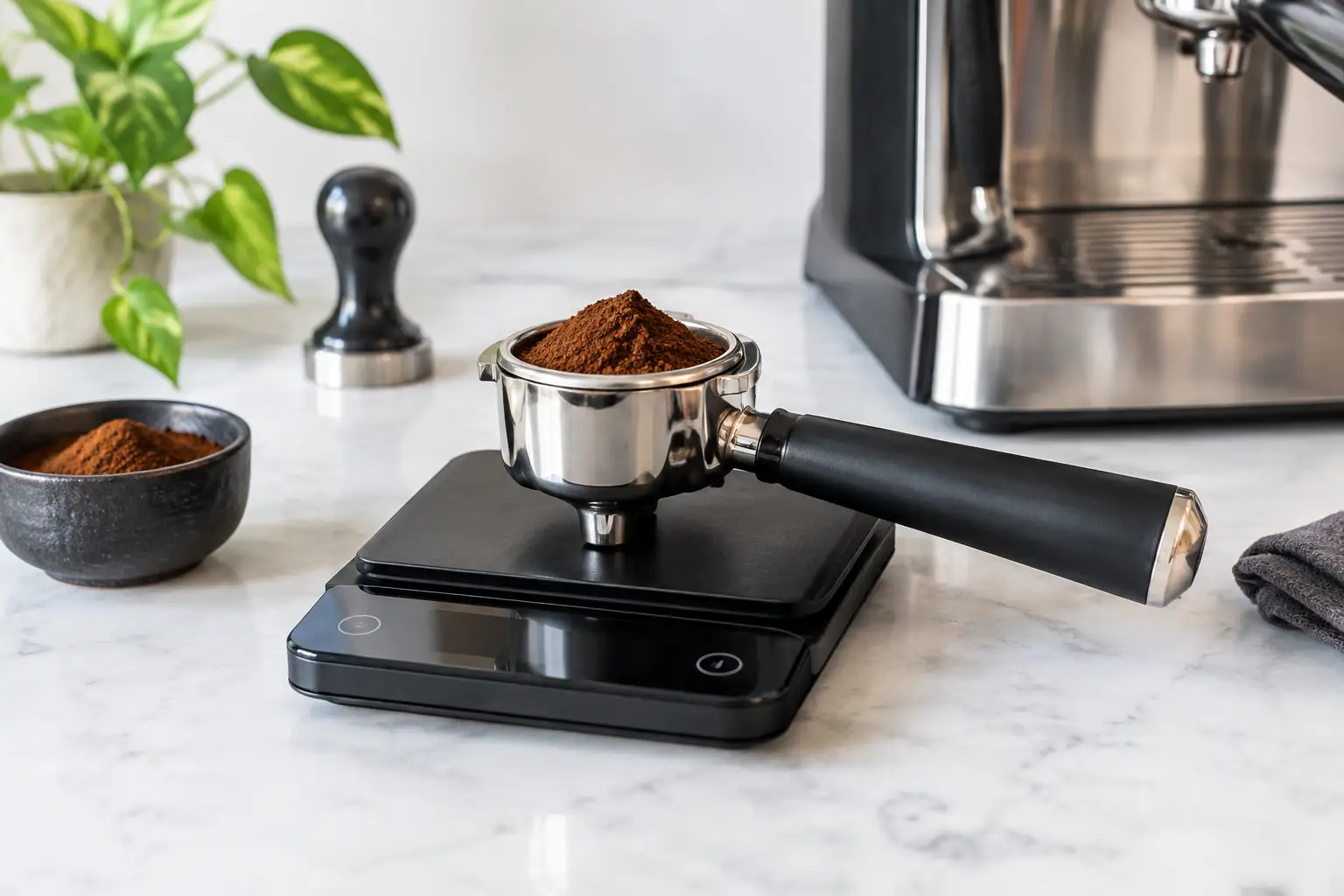
A shot can look perfect, run for 28 seconds, and still taste thin because the cup holds 34 grams instead of 40. That is why the best home espresso scales are not just accessories for obsessive coffee people. They are control tools. A fast, compact scale turns dialing in from a blurry ritual into a repeatable operating system: dose in, yield out, time recorded, adjustment made.
For an advanced home setup, the winning scale is rarely the one with the longest feature list. It is the one that fits beneath your portafilter, reacts quickly enough to catch the first drops, survives an occasional splash, and does not make the morning workflow slower.
What separates a useful espresso scale from a kitchen scale
Resolution matters, but only up to a point. A scale that reads in 0.1-gram increments is the practical standard for espresso. It lets you hit a 18-gram dose and a 36-gram yield with enough precision to taste the difference. Chasing 0.01-gram resolution usually adds cost without improving the cup, because puck prep, grinder retention, and machine temperature introduce larger variables.
Speed matters more than most buyers expect. A slow scale can lag by a second or two, causing you to stop the shot late. This becomes especially frustrating with low-flow profiling or machines that ramp quickly after preinfusion. Look for a scale with a responsive display and a stable reading, not merely an impressive maximum capacity.
The physical footprint is equally decisive. Many inexpensive coffee scales are too deep for a compact drip tray, forcing the cup forward or blocking the screen. Espresso-specific models are usually narrow, low-profile, and built with a silicone heat mat. Water resistance is valuable, but it is not an invitation to rinse the scale under a faucet. Wipe it down, keep coffee from reaching the charging port, and it will last far longer.
Automatic timing is useful only when it behaves predictably. Some scales start timing when they sense the first drip; others require a manual press. Automatic modes reduce button presses during service, but manual timing often gives cleaner control when your machine drips during preinfusion or purging. The right choice depends on how you pull shots, not on which mode sounds more advanced.
The best home espresso scales for serious daily use
1. Acaia Lunar: best overall for precision and speed
The Acaia Lunar remains the benchmark for a reason. It is compact enough for most home espresso machines, exceptionally quick to register changes, and designed around the actual mess of espresso service. Its 0.1-gram resolution, rechargeable battery, water-resistant construction, and responsive timer make it a serious workflow tool rather than a novelty gadget.
The trade-off is price. The Lunar costs several times more than capable budget models, and its app-connected features are unnecessary for many home users. Buy it if you make coffee every day, want highly consistent data while dialing in, or simply dislike tools that hesitate when you need them to react. It is the scale for the person who wants the variable removed from the system.
2. Timemore Black Mirror Nano: best value for most home bars
The Timemore Black Mirror Nano is the smart middle ground. It delivers the key espresso requirements: a compact platform, 0.1-gram precision, built-in timing, a rechargeable battery, and a clean display that is easy to read beneath a group head. It feels purpose-built without asking you to pay premium-brand pricing.
Its automatic functions can be less refined than Acaia’s, and the touch controls take a few uses to become instinctive. Still, for a home bar built around a quality grinder and a prosumer machine, the Nano is often the most rational purchase. Spend the difference on fresher coffee or a better basket.
3. SearchPean Tiny 2S: best compact budget pick
The SearchPean Tiny 2S earns its place because it solves the physical problem first. It is small enough to fit under many machines with cramped drip trays, yet it offers the 0.1-gram readability and timer function espresso demands. For a first dedicated coffee scale, that combination is more meaningful than elaborate connectivity.
Expect a more utilitarian experience than with premium scales. The materials, display speed, and long-term reliability may not match the Lunar. It is also worth checking the usable platform area if you pull shots into wide cappuccino cups. But for straight espresso, cortados, and compact home setups, it is a capable way to establish a disciplined shot routine without overinvesting.
4. Felicita Arc: best for app-minded enthusiasts
The Felicita Arc is a serious alternative for users who want scale data to extend beyond the shot itself. It offers fast response, compact dimensions, timer modes, and app integration for people who enjoy tracking recipes and comparing extraction variables over time. It is particularly appealing for home users who rotate coffees often and want a record of what worked.
That data layer is also its limitation. If you are not going to use the app, its value proposition narrows. The Arc still performs well as a standalone espresso scale, but buyers should not pay for analytics they will ignore. It is best for detail-oriented enthusiasts who treat coffee as an ongoing test kitchen.
5. DiFluid Microbalance: best for data-driven dialing in
DiFluid’s Microbalance is aimed squarely at the coffee tinkerer. Its appeal is not just weight and time, but richer feedback around flow and brewing behavior. Used thoughtfully, that information can help diagnose a shot that starts well and runs away late, or reveal whether a grind adjustment actually changed the extraction pattern.
This is not the scale to buy for a frictionless, button-free morning. It has a learning curve, and the analysis can become distracting if you have not first established sound fundamentals: stable dose, calibrated grinder, good distribution, and a repeatable puck-prep process. For an enthusiast who already has those basics locked down, it offers meaningful visibility into the shot.
6. MiiCoffee Nano: best low-cost auto-timer option
The MiiCoffee Nano targets buyers who want espresso-specific functions at an entry-level price. Its small body, 0.1-gram increments, timer modes, and rechargeable design cover the core requirements better than a generic kitchen scale ever will. It is a practical match for a starter machine that lacks much clearance below the portafilter.
The compromise is quality control and interface polish. Budget electronic scales can vary more from unit to unit, and touch controls are rarely as satisfying as physical buttons when your hands are damp. Treat it as a functional tool, protect it from heat and standing water, and it can provide the numbers needed to build consistent habits.
7. Acaia Pyxis: best ultra-compact premium option
The Acaia Pyxis is for the home bar where every millimeter matters. Its extremely small format makes it useful under machines with restrictive tray space and for espresso drinkers who prefer compact cups. It brings premium responsiveness and build quality to a format that can disappear into a small apartment kitchen.
Its limitations are obvious: the platform is tiny, the price is high, and it is not the most versatile choice for larger cups or pour-over brewing. This is a specialized purchase. If your machine has room for a standard espresso scale, the Lunar or Timemore Nano is easier to live with. If it does not, the Pyxis can be the difference between weighing every shot and giving up on the practice.
Build the scale into your espresso workflow
A scale only improves coffee when it informs a decision. Start with a fixed dose, such as 18 grams, and select a target yield based on your basket and coffee. A common baseline is a 1:2 ratio, meaning 18 grams in and 36 grams out. Record the time from pump activation to target yield, then taste before changing anything.
If the cup is sharp, thin, and fast, grind finer. If it is bitter, dry, and slow, grind coarser. Change one variable at a time. Do not respond to a disappointing shot by changing dose, temperature, yield, and grind setting simultaneously. That is not dialing in. It is deleting the evidence.
Keep the scale on the tray during every test shot, even when you think the recipe is settled. Beans age after opening, room humidity shifts, and grinders retain coffee. The small act of weighing output catches drift before it becomes a week of mediocre espresso.
The best purchase is the scale you will leave on the machine and use without thinking. Choose the footprint your setup can accommodate, prioritize fast response over gimmicks, and let the numbers turn each coffee bag into a manageable, repeatable system.