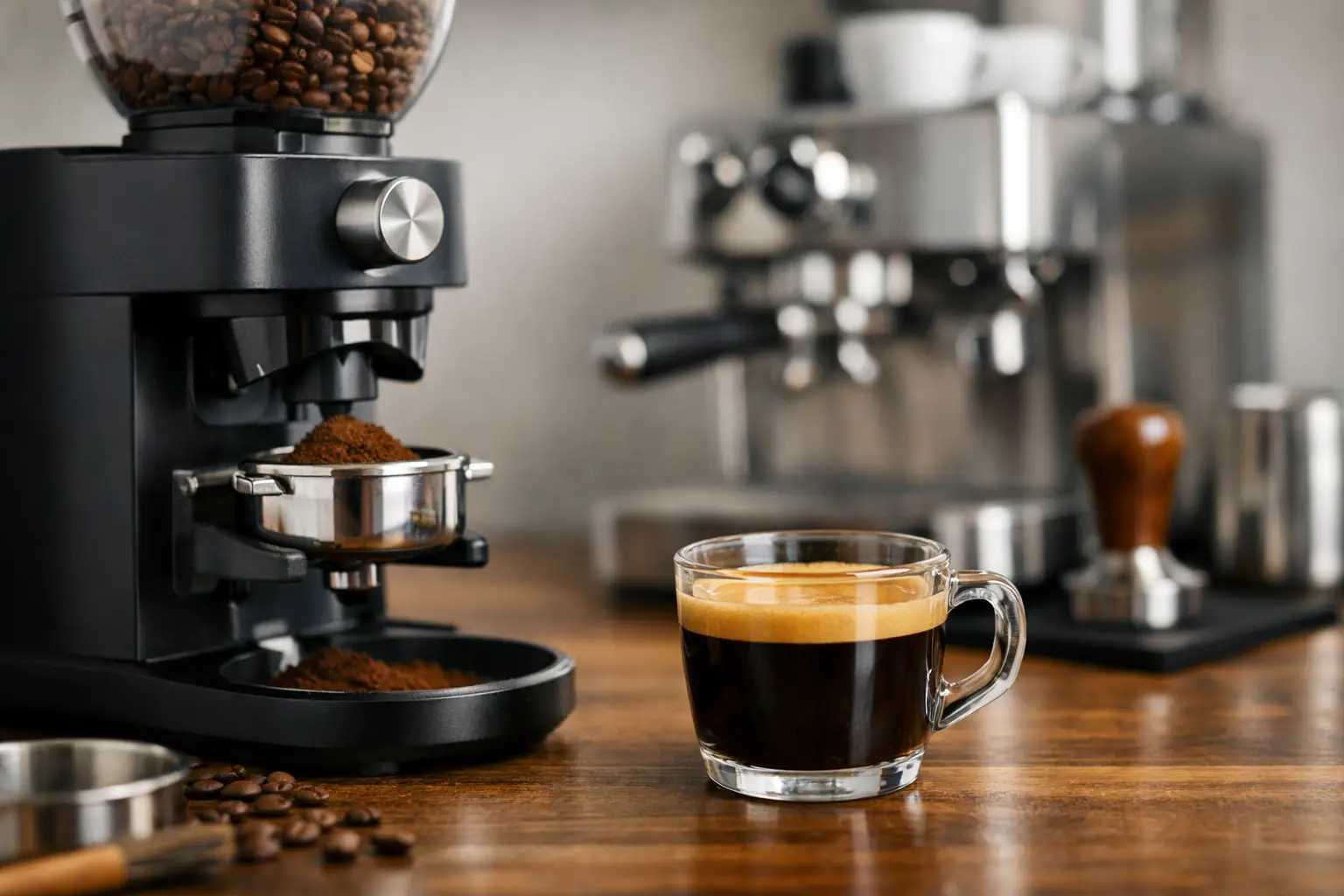
A $2,000 espresso machine cannot compensate for a grinder that delivers uneven particles, traps yesterday’s grounds, or forces you to make giant adjustment jumps. The grinder is where a home espresso setup becomes either a repeatable system or an expensive daily guessing game. This home espresso grinder guide focuses on the variables that actually affect the cup: particle consistency, adjustment precision, retention, workflow, and the kind of coffee you intend to drink.
Start With the Workflow, Not the Price Tag
Most buying mistakes start with an abstract question: “What is the best grinder?” There is no useful universal answer. A person making two milk drinks before work needs a different machine than someone who rotates between light-roast single origins and pulls five experimental shots on Saturday.
Define the operating conditions first. How many drinks will you make each day? Will you use one dependable medium roast for weeks, or change beans constantly? Do you want to grind directly into the portafilter, dose beans one serving at a time, or keep a full hopper loaded? Those decisions narrow the field faster than brand reputation or a long feature list.
For a stable routine with one coffee, a hopper-fed grinder can be practical. It reduces steps and keeps the counter moving during a busy morning. For someone who buys fresh coffee in smaller quantities and switches bags often, a single-dose setup is usually more logical. You weigh the beans, grind them through, and avoid leaving a large volume of coffee exposed to air in the hopper.
Neither workflow is inherently more serious. The correct choice is the one you will execute consistently before your first meeting of the day.
The Home Espresso Grinder Guide to Burrs
Burr geometry matters because espresso needs a tight, controlled range of particle sizes. The goal is not simply to grind coffee very fine. It is to produce enough similarly sized particles that water moves through the puck at a predictable rate, extracting sweetness without racing through weak spots or choking entirely.
Conical burrs favor body and flexibility
Conical burr grinders are common in home machines for good reasons. They can be compact, relatively quiet, and capable of producing shots with substantial body and texture. Many are forgiving with traditional medium and medium-dark espresso, especially when milk is part of the plan.
Their trade-off is often a broader particle distribution than a well-designed flat burr grinder. That can be pleasant, particularly for chocolatey, caramel-heavy coffees, but it may make it harder to isolate delicate fruit and floral notes in a light roast. This is not a rule without exceptions. Burr design, motor speed, alignment, and the rest of the machine all matter.
Flat burrs reward precision
Flat burr grinders frequently appeal to the home barista chasing clarity and high extraction. Their particle output can emphasize separation between flavors, making a washed Ethiopian or modern light-roast espresso feel more vivid and structured.
The trade-off is that flat-burr machines may be larger, louder, and more expensive. Some also benefit from a break-in period, during which the burrs settle and the grind behavior changes slightly. If your ideal espresso is syrupy, traditional, and usually paired with steamed milk, paying a premium for flavor separation may not improve your actual morning experience.
Do not treat burr shape as a quality ranking. Treat it as a flavor and workflow decision.
Adjustment Precision Is the Non-Negotiable Feature
Espresso often requires changing the grind by a tiny amount. A shot that runs in 21 seconds may need only a small move finer to reach a balanced 28-second extraction. If the adjustment mechanism makes broad jumps, you can land in a frustrating gap: one setting runs too fast, the next chokes the machine.
Look for stepless adjustment or a finely stepped system designed specifically for espresso. Stepless grinders offer nearly continuous control. They are excellent when you want to tune a coffee precisely, though they can be less convenient if multiple people regularly use different recipes. Fine stepped systems are easier to return to a known setting, provided the step size is narrow enough.
A grinder marketed for “espresso and drip” deserves extra scrutiny. Many all-purpose grinders can technically produce espresso-fine grounds, but their adjustment range around espresso may be too coarse for reliable dialing in. The issue is not whether the grinder reaches fine enough. It is whether it gives you enough useful settings once you get there.
For a household that alternates between espresso and pour-over, a dedicated espresso grinder plus a separate brew grinder can be a more efficient long-term system. It sounds excessive until you calculate the time spent losing your espresso setting, purging coffee, and recalibrating every other day.
Retention Changes the First Shot of the Day
Retention is the amount of ground coffee left behind in the grinder after a dose. It collects in the chute, around the burr chamber, and sometimes in surprisingly hidden spaces. High retention means your first shot can include a meaningful amount of yesterday’s coffee, while the dose you weighed does not fully reach the basket.
This is especially relevant for single dosing. A low-retention grinder should deliver nearly all the coffee you put in, with a small, predictable remainder. Some users use a bellows attachment to push out retained grounds. That can work well, but it should not be necessary to rescue a fundamentally messy design.
For hopper users, retention is less disruptive when the same coffee runs through the grinder every day. Fresh grounds continually push older grounds forward. Even then, a grinder with excessive retention creates stale pockets and makes cleaning more difficult.
Static is part of this equation. Dry coffee and dry indoor air can cause grounds to cling to the exit chute or scatter across the counter. A light mist of water on the beans before grinding, often called the Ross Droplet Technique, can reduce static. Use only a tiny amount. You are managing charge, not washing the coffee.
Build a Repeatable Dose-to-Cup System
An espresso grinder cannot deliver consistency if the surrounding workflow is random. Establish a baseline recipe before you start chasing the perfect setting. A practical starting point is 18 grams of coffee in, 36 grams of espresso out, in roughly 25 to 30 seconds. Your coffee, basket, and machine may prefer something different, but this gives you a controlled reference point.
Change one variable at a time. If the shot tastes sour and thin, grind a little finer or extend the yield, then test again. If it tastes harsh, dry, and overly bitter, try a slightly coarser grind or a shorter yield. Changing dose, yield, temperature, and grind at once produces noise instead of information.
A small scale with 0.1-gram resolution is more useful than a bag of expensive accessories. Weigh the dose and the beverage output. Track your grinder setting in a note on your phone or a label near the machine. Coffee ages after roasting, humidity shifts, and a new bag may need a different setting. A record turns those adjustments into routine maintenance instead of daily mystery.
Puck preparation also deserves discipline. Distribute grounds evenly, break up visible clumps, and tamp level with consistent pressure. Modern precision baskets can improve results, but they also expose poor distribution and sloppy dosing. Upgrade the grinder and workflow first, then add specialized tools if they solve a specific problem.
Motor Speed, Noise, and Heat Are Real Trade-Offs
Grinder marketing often turns RPM into a simple virtue: lower is gentler, higher is faster. The reality is more complicated. Motor speed interacts with burr size, burr geometry, torque, and the grinder’s feed design. A well-engineered grinder can produce excellent espresso at different speeds.
At home, the practical questions are simpler. Does it grind an 18-gram dose quickly enough for your routine? Does it stall on light-roast coffee? Is the noise level acceptable in a shared apartment at 6:30 a.m.? Is the motor system built for a few daily doses or a family that treats the kitchen like a compact café?
Heat is usually overstated for normal home use. Grinding one or two doses does not create the thermal load of a busy commercial bar. It becomes more relevant when making many drinks back to back, or when a grinder has a weak motor and struggles through dense, light-roast beans.
Spend for the Bottleneck You Actually Have
A capable espresso grinder should receive a meaningful share of your total setup budget. If the choice is between a flashy machine with a weak grinder and a modest machine paired with a precise grinder, choose the second setup. Better grounds give you more control over extraction, which is the central problem espresso asks you to solve.
That does not mean everyone needs premium flat burrs and an elaborate single-dose station. A dependable espresso-focused grinder with fine adjustment, manageable retention, and a workflow that suits your household can produce excellent coffee for years. Buy capacity and complexity only when your habits require them.
The best signal that you chose well is not a spec sheet. It is this: when a new bag of coffee arrives, you can dial it in calmly, reproduce a good shot tomorrow, and make coffee without turning your kitchen into a troubleshooting lab.
If you found these tips helpful, explore more of our food & cooking guides.