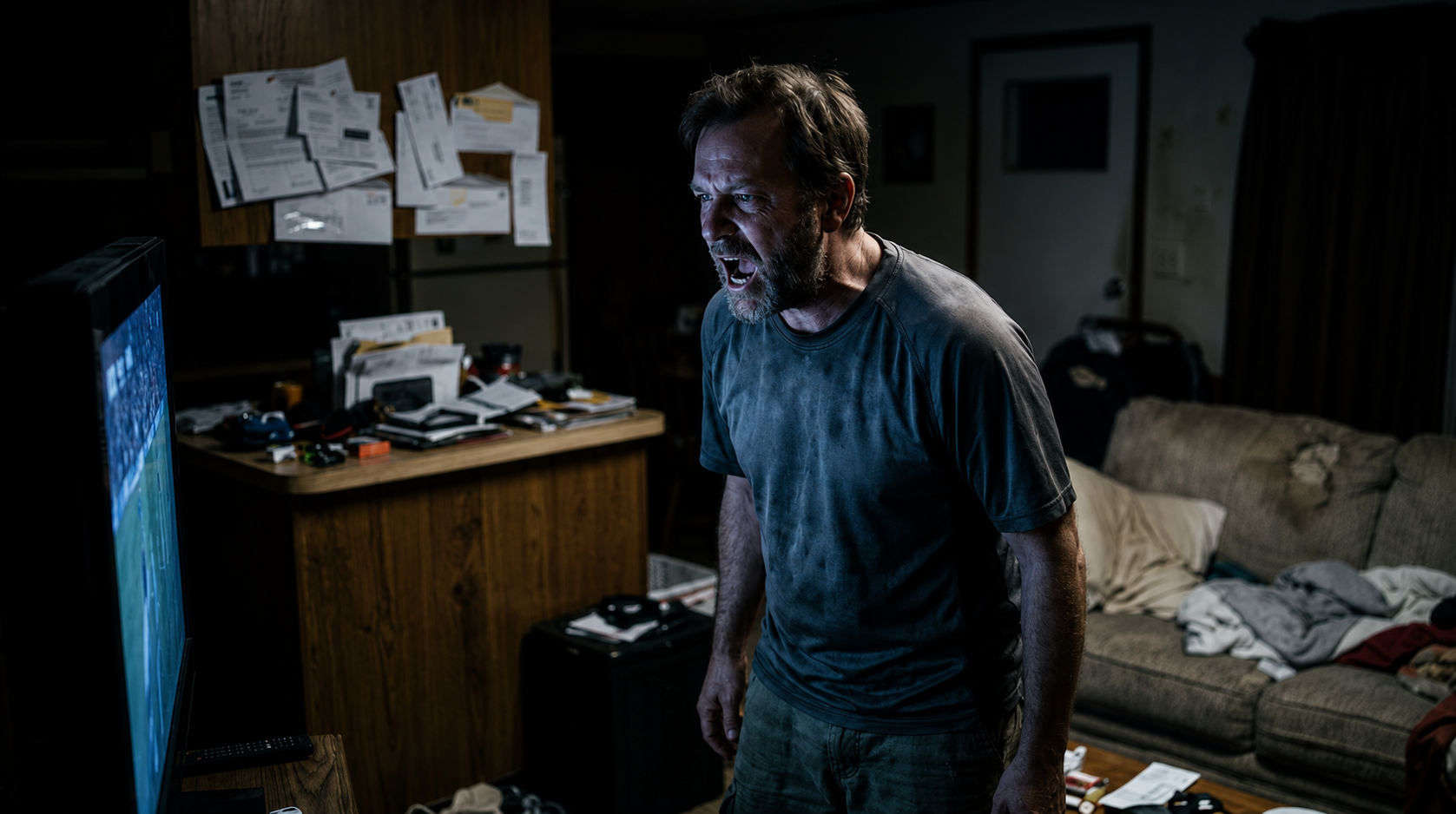
The scream that gives it away
There is a particular sound that comes out of a man standing in front of a television during a World Cup match. It is not the sound of joy. It is not even really the sound of anger at a missed pass or a bad referee call. It is something closer to grief, dressed up as rage. And the strange thing about that sound is that the louder it gets, the more it tells you about the person making it, and the less it has to do with the actual game.
I have said this before and I will say it again because it keeps proving itself true every four years. The more a person shouts at the screen, the more obvious it becomes how empty, how hollow, how sad their personal life really is. They are not shouting because their team is losing. They are shouting because, in their own head, this game was the only place left where they could still say the words “we won.” Ganamos. That word is not about football. It is about everything else.
What the win is covering up
Think about who is doing the shouting. Strip away the jersey and the face paint and look at the actual life underneath. Most of the time you find the same pattern. School did not go well. The job is not impressive, or there is no job. The bank account is thin, and there are debts spread across every card and loan the banks were willing to hand out. The body in the mirror is not the body he wanted. The face does not have the skin tone or the eye color that gets praised in this culture. The kids do not really respect him. The marriage is not warm. The relationship with his own siblings and parents is complicated at best, and at worst it is a wound nobody talks about at the dinner table.
Now put that same man next to a neighbor or a childhood friend who has more. More money, more respect, a better marriage, a life that looks like it is actually working. That comparison sits in the back of the mind every single day, quiet but constant. And there is no easy way to close that gap. School is finished. The career already took the shape it took. The marriage is what it is. But once every four years, something shows up that offers a shortcut. A team wearing his country’s colors starts winning games, and suddenly he has a legitimate reason to walk out into the street with his shirt on, chest out, head high, and scream at the top of his lungs that he won something. That his country won something. That he, personally, finally has a win to point to.
When that word “we” comes out of his mouth, it is not really about the eleven men on the pitch. It is an attempt to borrow an identity he never earned, to paper over a reality he feels stuck inside of.
The psychology has a name, and it is older than this World Cup
This is not just an opinion. Social psychologists have been studying exactly this behavior since the 1970s, and the research lines up almost perfectly with what plays out in the streets every World Cup.
In 1976, a psychologist named Robert Cialdini and his colleagues ran a set of field studies at seven American universities. They tracked something simple. On the Monday after a college football game, did students wear clothing with their school’s name on it more often after a win than after a loss. The answer was yes, and the bigger the win, the more school apparel showed up on campus. But the more revealing part of the study came from a second experiment. Cialdini’s team called students on the phone and asked them to describe how their school’s football team had done over the weekend. When the team had won, students overwhelmingly said “we won.” When the team had lost, the same students distanced themselves from the result and said “they lost.” The word “we” only came out when there was glory attached to it. Cialdini called this basking in reflected glory, or BIRGing, and it has been replicated again and again since then, including a 2016 re-run of the original study forty years later that found the same pattern, if anything stronger.
There is a second half to this theory that matters just as much, something researchers call cutting off reflected failure, or CORFing. People do not just attach themselves to winners. They actively detach from losers to protect their own image. That is why the same fan who screamed “ganamos” after a win will go quiet, or blame the coach, the referee, the weak players, anyone but himself, the moment the team loses. The win is personal. The loss is always someone else’s fault. That asymmetry is not an accident. It is the entire point of the behavior.
Later research pushed this further and found that the pull toward BIRGing gets stronger specifically when a person’s own sense of self is under threat. In other words, it is not random who screams the loudest. It tends to be the people whose everyday identity already feels shaky, whose self image needs propping up. A man with a stable, satisfying life does not need to borrow a nation’s win to feel like something. A man whose life feels like a pile of unmet expectations does.
This connects to an even older idea in psychology called Social Identity Theory, developed by Henri Tajfel in the 1970s. Tajfel showed that people do not just build their sense of self from their own achievements. They build a large part of it from the groups they belong to, even groups they had no hand in creating and no control over, like a nationality or a school they happened to attend. When the personal side of identity is thin, people lean harder on the group side to fill the gap. A national football team is one of the most powerful group identities available to an ordinary person, because it asks nothing of him except to be born in the right place and to show up with the right colors on.
Rage is not really about the missed shot
This is why the fury makes sense once you see it clearly. The broken television, the thrown chair, the fight that breaks out in the street over a missed penalty, none of that is really about the missed penalty. That shot did not just cost the team a goal. In the fan’s mind, it cost him the one win he had been counting on for the entire month. The screen becomes a lightning rod for an entire life of accumulated frustration that had nowhere else acceptable to go.
It is far easier to scream at a referee on a screen than to sit alone and face a marriage that has gone cold, or a stack of unpaid credit card bills, or a career that stalled out years ago. The stadium shirt works like a piece of armor. It lets a man walk into the street with a kind of pride he cannot access anywhere else in his actual life, because facing that actual life honestly, head held high, feels impossible most days.
History has already shown what happens when this pressure valve gets pushed too far. In 1969, tensions during World Cup qualifying matches between El Salvador and Honduras helped ignite what became known as the Football War, a real armed conflict between the two countries. The football matches were not the true cause, the underlying issues were land disputes and mass migration, but the football rivalry poured fuel directly onto a fire that was already burning under the surface, and it did so because national pride and personal grievance had already become fused together in the public mind. English football hooliganism through the 1970s and 80s followed a similar pattern, young men from economically depressed towns turning stadium rivalries into a substitute battlefield for status and belonging that their actual daily lives were not providing.
The Romans already figured out how to sell this
None of this is new, and that is the part that should really unsettle people. Almost two thousand years ago, the Roman poet Juvenal wrote about a public that had stopped caring about anything serious and could be kept calm and controlled with just two things, bread and circuses, panem et circenses. Feed people, entertain people, give them a spectacle to lose themselves in, and they will stop asking harder questions about the state of their own lives or the state of the empire running things above their heads. The Colosseum was not built because Rome loved sport for its own sake. It was built because a distracted, entertained population is an easier population to manage.
Modern football is the same machine wearing a new uniform. The people who own the clubs, run the federations, and sell the broadcasting rights understand exactly what Cialdini and Tajfel later put a name to. They know that football is not being sold as a game. It is being sold as a religion, a tribal duty, an identity a person can buy into with a jersey that costs more than it should. They are not marketing to people with stable, full lives who watch football purely for the enjoyment of the sport. They are marketing to the exact void described above, the man who needs a win he did not earn, and they are doing it deliberately, because that man will spend money he does not have on a shirt, a ticket, a subscription package, all to rent a feeling of victory for ninety minutes.
That is the most cynical part of the whole machine. The very insecurity that makes a person scream “ganamos” in the street is the same insecurity being carefully cultivated and monetized by billionaires who never once kick the ball themselves.
Seeing it clearly is what breaks the spell
Once this pattern is visible, it does not come back off. The loud, chaotic energy that fills bars and streets during a World Cup stops looking like a vibrant expression of culture and starts looking like what it actually is, a collective, very public cry for a sense of purpose that is missing somewhere else. The noise is not celebration in its purest form. A lot of it is grief wearing a national flag.
That is not a reason to hate football, and it is not a reason to look down on every person who enjoys a match. There is a real, healthy version of sport, watching with friends, appreciating skill, feeling a light and passing connection to a shared moment. That version does not need the word “we” to carry the weight of an entire unlived life. The difference shows up the moment the team loses. A person with a full life outside the game shrugs it off and goes back to his week. A person using the game to fill a void goes home and the emptiness is still sitting there waiting for him, now louder than before, because for ninety minutes he almost believed he had escaped it.
Walking away from that circus is not walking away from football. It is walking away from using someone else’s ninety minutes as a stand in for a win a person was supposed to build for himself.