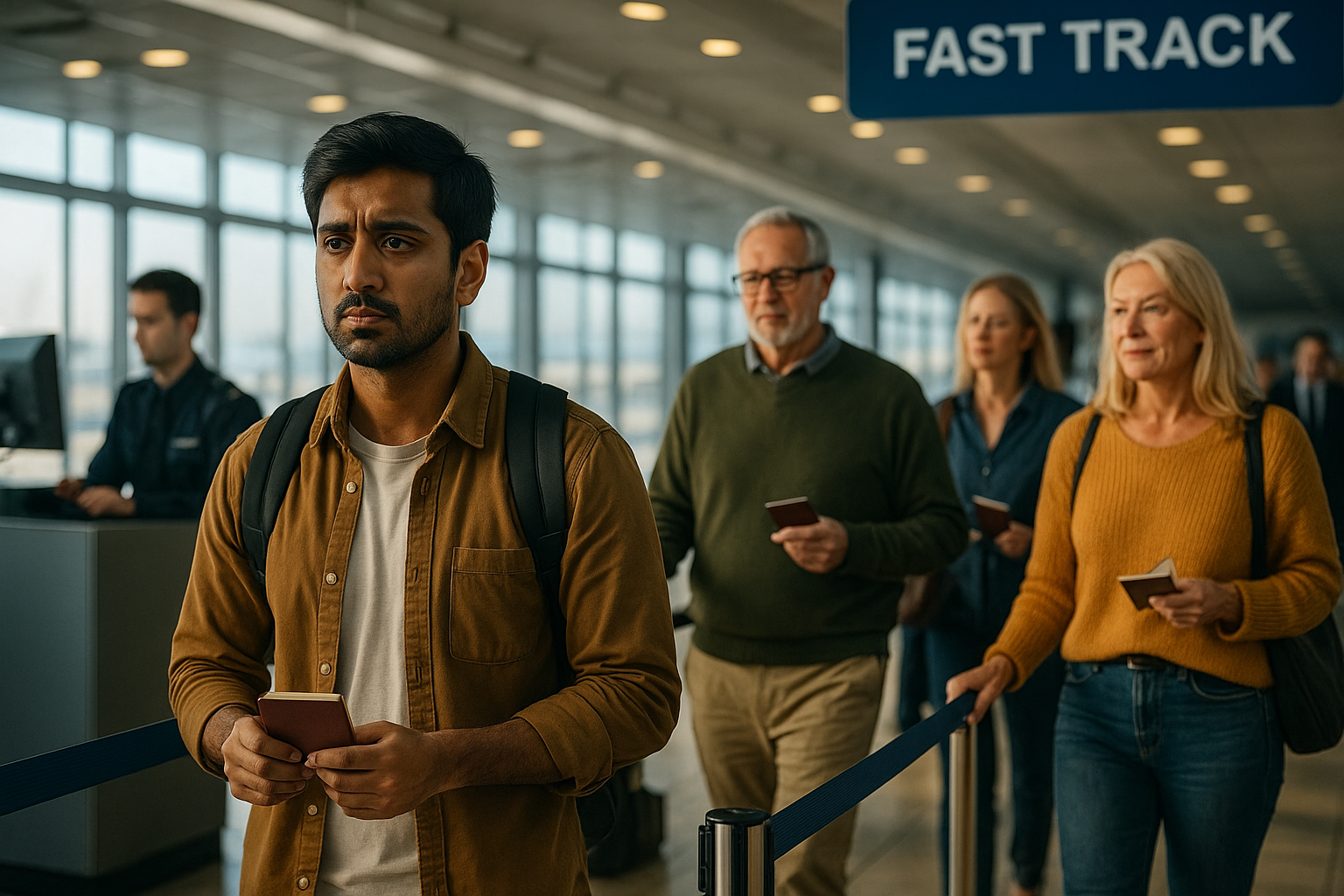
Some people move across borders with ease.
Others spend years — even decades — proving they deserve to exist somewhere.
This isn’t about crime or legality. It’s about passport privilege — the invisible system that rewards you or restricts you based on the country listed on your birth certificate.
When Nationality Outweighs Everything Else
I met Ali (name changed), a Pakistani-born business consultant, over coffee in Madrid. He had built a full life in Mexico — a thriving consultancy, a clean immigration record, and marriage to a Mexican woman who recently became a Spanish citizen.
But the moment he tried moving to Spain with her, everything collapsed into red tape.
“None of it mattered,” he said. “All they saw was my passport.”
A Tale of Two Travelers
Ali described a morning at Mexico City’s immigration office. The sign said “First come, first served.” He arrived before sunrise. Hours later, he watched as Americans and Canadians who showed up after him were called ahead.
“It wasn’t subtle. Everyone with a premium passport got treated like a VIP.”
His wife wanted to speak up — but he told her not to. He couldn’t risk it. One complaint, one raised voice, and his years of effort could vanish with a single stamp.
The Global Inequality of Mobility
According to the 2024 Henley Passport Index:
-
A Japanese passport allows visa-free access to 193 countries
-
A Pakistani passport? Just 32
But the issue runs deeper than travel destinations.
The World Bank’s Global Mobility Report (2023) revealed:
-
Application processing times are three times longer for citizens of developing countries
-
Document requirements are four times more demanding
-
Rejection rates are five times higher — even for the same visa
The Paper Chase No One Prepares You For
Ali’s path to residency in Spain turned into a labyrinth:
-
Background checks from both federal and state agencies in Mexico
-
A new birth certificate — the old one was “too old”
-
Certification from the Mexican embassy that handles Pakistani nationals — in Iran
-
No mail route between Mexico and Iran
So even if he managed to get the new document, there was no legal way to send it where it needed to go.
“It’s absurd,” he said. “It’s like a maze designed to make you fail.”
The Price of Proving You Belong
The UN Human Rights Office reported in 2023 that applicants from developing countries often pay 400% more for the same visa processes.
The expenses pile up:
-
Document fees
-
Embassy authentication
-
Legalized translations
-
Reapplications due to delays
-
Expedited shipping when deadlines clash
But the real cost is harder to measure:
Stress. Time. Dignity.
“You constantly feel like you’re guilty until proven innocent,” Ali told me. “And even then, you’re still not trusted.”
Even Citizenship Has Limits
Ali’s wife — now officially a Spanish citizen — couldn’t open a bank account, rent an apartment, or even buy a SIM card.
Why? She didn’t have her DNI (national ID card).
To get that, she needed a special version of her birth certificate. Estimated delivery time: several months.
“She’s legally Spanish,” Ali said. “But she can’t function in her own country.”
What It’s Costing the World
This isn’t just about individual frustration.
According to the McKinsey Global Institute, reducing global mobility barriers could increase global GDP by $78 trillion by 2025.
That’s not just a statistic. It’s a reflection of what’s being lost:
-
Talented professionals stuck in paperwork
-
Entrepreneurs unable to launch
-
Ideas and skills never reaching where they’re needed
-
A global economy bottlenecked by outdated systems
What Needs to Change
If we’re serious about fairness, we need to stop pretending this system is neutral. Here are some starting points:
-
Acknowledge that nationality often overrides merit
-
Question policies that penalize people for where they were born
-
Push companies to support employees through real visa challenges
-
Share these stories — especially if you’ve never had to think about your own passport
Silence keeps the system intact. Visibility is the first step to dismantling it.
A Closing Reflection
“The same countries that make it impossible for people like me to enter legally,” Ali said, “are the ones that complain most about illegal immigration.”
We’ve built a world where money moves across borders in seconds, but human lives are held up by paperwork that takes months — or years.
That’s not just inefficient. It’s unjust.
The question we must ask is simple: Do we want to keep judging human worth by lines on a map?
Have you lived through passport privilege or visa discrimination? Share your story in the comments — not for sympathy, but for solidarity.