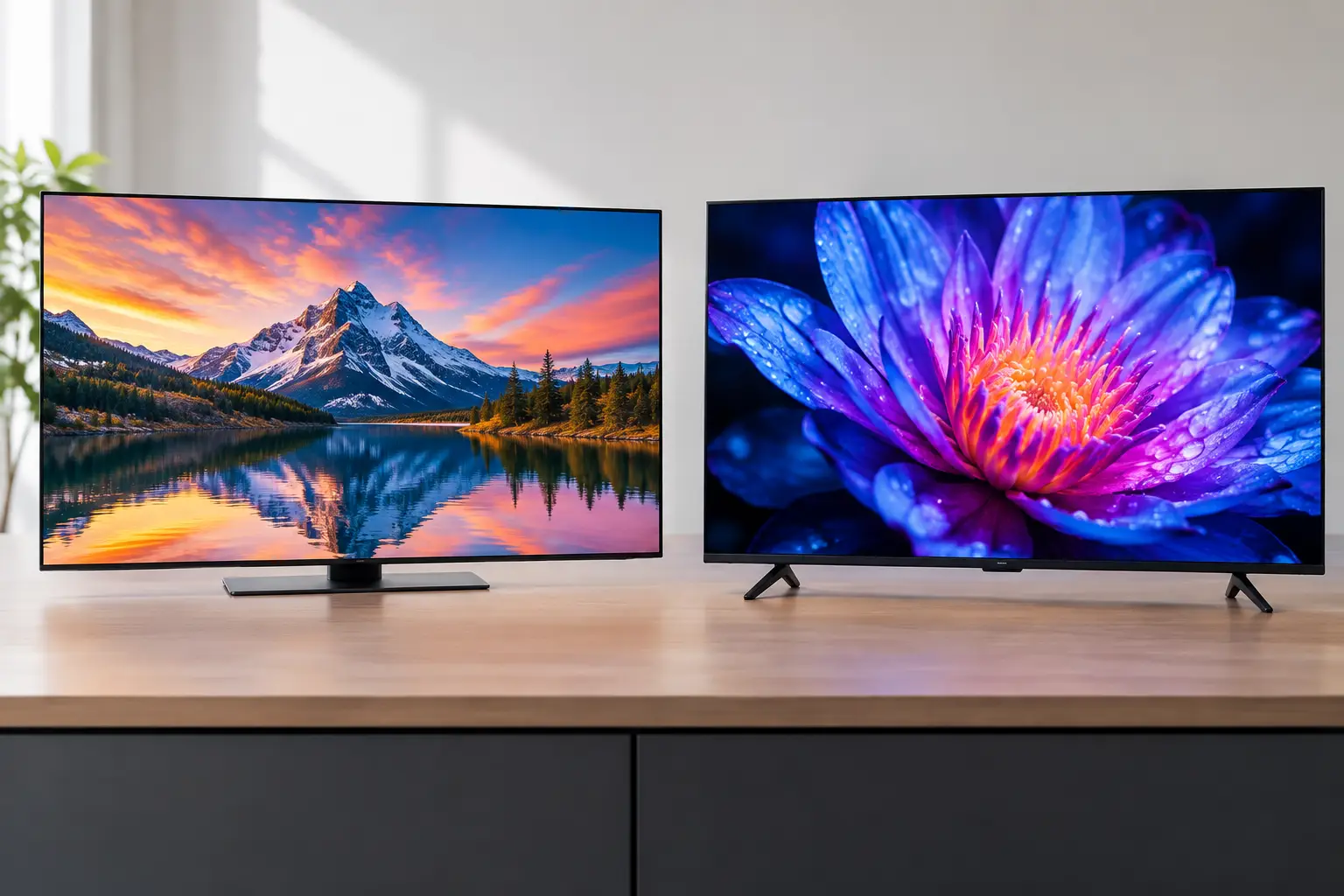
A flagship TV can now cost less than a used car, while a wall-sized display can cost more than a new one. That gap explains the real story behind OLED versus MicroLED displays. These are not two interchangeable premium screen labels. They are different hardware bets with different strengths, failure modes, and buying timelines.
For most households, creators, and hybrid workers, OLED is the technology you can buy, evaluate, and build into a setup right now. MicroLED remains the aspirational option: technically extraordinary, commercially scarce, and priced for luxury installations or commercial environments. The smart decision is not about choosing the most advanced acronym. It is about matching display behavior to the room, the content, and the years you expect to keep it.
OLED versus MicroLED displays: the practical divide
OLED panels use self-emissive pixels. Each pixel creates its own light and can turn fully off, which produces true black levels and extremely precise contrast. In a dark movie scene, an OLED does not have to dim a backlight behind the image. A black area can simply be black.
MicroLED also uses self-emissive pixels, but its pixels are microscopic inorganic LEDs rather than organic compounds. That material difference matters. MicroLED is designed to deliver OLED-like pixel-level control while pushing much higher brightness and offering stronger resistance to image retention. In theory, it combines the black levels people love in OLED with the light output and durability associated with premium LED signage.
In practice, the word “theory” carries weight. OLED is a mature consumer category with options across TVs, phones, laptops, tablets, and monitors. MicroLED is difficult to manufacture because millions of tiny LEDs must be placed, aligned, and tested with extreme precision. That complexity is why the technology still appears mainly in ultra-premium modular displays, specialty products, and commercial installations.
Picture quality is not a one-column comparison
OLED has earned its reputation because the image looks controlled rather than merely bright. Its contrast gives films, prestige TV, and dark games a sense of depth that conventional LED-backlit screens still struggle to match. Viewing angles are excellent, motion performance is fast, and a good OLED can make a modestly lit room feel more cinematic without elaborate calibration.
MicroLED can potentially produce the same deep blacks while holding onto far more brightness. That advantage becomes meaningful in sun-heavy living rooms, glass-walled offices, retail settings, and large spaces where a display must compete with ambient light. High brightness also gives highlights more visual impact in HDR material, provided the content and processing are handled well.
But brightness is not automatically better. A display that is overwhelmingly bright at night can create eye fatigue, flatten the mood of film content, and expose poor compression in streaming video. Most people do not need a screen engineered to overpower a showroom floor. They need one that looks convincing during a Saturday afternoon sports broadcast and restrained during a late-night movie.
OLED also has a practical advantage in panel uniformity and consumer-ready tuning. The best OLED TVs are widely reviewed, readily calibrated, and supported by established gaming features. With MicroLED, individual installations can vary more because the product is often modular and professionally configured. The hardware may be remarkable, but the buying process is less standardized.
The burn-in question needs a realistic answer
Burn-in is still the most common objection to OLED, and it deserves more than a dismissive answer. Persistent static elements, such as news tickers, game HUDs, desktop taskbars, editing interfaces, or digital signage, can create uneven pixel wear over time. Modern OLED devices use pixel shifting, screen savers, logo dimming, and compensation cycles to reduce the risk. Those systems work, but they do not erase the underlying physics.
For normal mixed TV use, OLED burn-in is a manageable concern rather than a reason to avoid the category. A household that watches varied programming, plays games, and streams movies is unlikely to treat a modern OLED like a fragile museum piece. The risk rises when the same bright interface remains on-screen for long daily stretches.
That makes usage pattern more important than marketing claims. A video editor who keeps timeline controls visible for eight hours a day, a trader with static dashboards, or a business running menu boards should think carefully before choosing OLED as a primary work display. MicroLED is much better positioned for these persistent-image environments because inorganic LEDs are more resistant to differential aging.
For desktop work, there is another consideration: text rendering. OLED monitors have improved substantially, but some panel structures can make fine text look less crisp than a high-quality LCD at close range. If your day is mostly spreadsheets, browser tabs, code, and documents, an OLED monitor should be tested in person whenever possible. The dramatic black level may matter less than comfortable text clarity at 9:30 a.m. on a Tuesday.
Price and availability change the recommendation
The consumer OLED market is competitive. You can find credible OLED televisions at several screen sizes, and the category often sees meaningful seasonal discounts. Premium models still command premium prices, but the purchase is within reach for buyers already considering a high-end TV, gaming monitor, or laptop.
MicroLED pricing is on a different planet. Its cost reflects manufacturing yield, installation requirements, custom configurations, and limited production scale. Even when smaller MicroLED products emerge, they are likely to enter the market as halo products rather than immediate replacements for mainstream OLED TVs.
That reality matters because display technology does not exist in isolation. A budget spent on a MicroLED installation could also fund better room lighting, a serious audio system, acoustic treatment, a media server, or a complete creator workstation. Systems thinking beats spec-sheet worship. A high-quality OLED paired with proper seating distance and controlled lighting will outperform a poorly planned luxury display setup in daily satisfaction.
Choose based on the job your screen must do
An OLED TV is the strongest choice for most premium living rooms, dedicated media rooms, and gaming setups. It delivers exceptional contrast, wide viewing angles, and mature features at a price that, while not cheap, belongs in a real consumer buying decision. It is especially compelling if you watch movies at night or care about visual detail in games.
MicroLED makes more sense when the screen is a permanent architectural feature or a high-visibility business asset. Think luxury residences with custom wall installations, executive briefing rooms, high-end hospitality spaces, broadcast environments, and premium retail. Its brightness, durability, and modular scaling are meaningful advantages where the budget and installation process are already substantial.
For creators, the answer depends on workflow. An OLED reference display can be excellent for color-sensitive video work, provided it is calibrated and used with sensible pixel-care habits. A creator who spends most of the day in static interfaces may prefer a different primary monitor and reserve OLED for previewing footage, gaming, or finished visual work.
Parents and mixed-use households should also avoid turning this into a purity test. If a TV will run kids’ channels, sports, console games, and streaming apps all day, an OLED can still be a strong purchase. Just enable its panel-protection features, avoid leaving paused screens up for hours, and buy from a manufacturer with a warranty policy you understand.
The overlooked issue: installation and ownership
OLED behaves like familiar consumer electronics. You select a size, mount it or place it on a stand, connect your devices, tune picture settings, and use it. There are details around ventilation, brightness settings, and panel care, but the ownership model is straightforward.
MicroLED can be an installation project. Modular panels may require site measurement, wall preparation, professional assembly, calibration, cable planning, and ongoing service support. That is not a flaw. It is the reason MicroLED can scale into enormous, nearly bezel-free video walls. It also means it should be evaluated like a custom home or business system, not an impulse replacement for a 65-inch TV.
Ask a simple question before comparing peak brightness charts: if something needs adjustment in three years, who handles it? For OLED, the answer is usually a retailer, manufacturer, or local technician. For MicroLED, the answer may depend on the installer, integrator, module availability, and service agreement. Hardware ownership includes maintenance logistics.
Where the market is actually headed
MicroLED is not likely to erase OLED from consumer shopping lists soon. The more plausible near-term future is segmentation. OLED will continue to improve in brightness, efficiency, panel longevity, and screen sizes. MicroLED will develop first where its price is justified by scale, brightness, longevity, and design flexibility.
That is good news for buyers. OLED competition is already producing better screens at more attainable prices, while MicroLED is forcing the upper end of the market to rethink what a display can be. You do not need to wait for a distant perfect technology if an OLED fits your current room and habits. Buy the screen that serves your real routine, then build the rest of the setup around how you actually watch, work, and play.