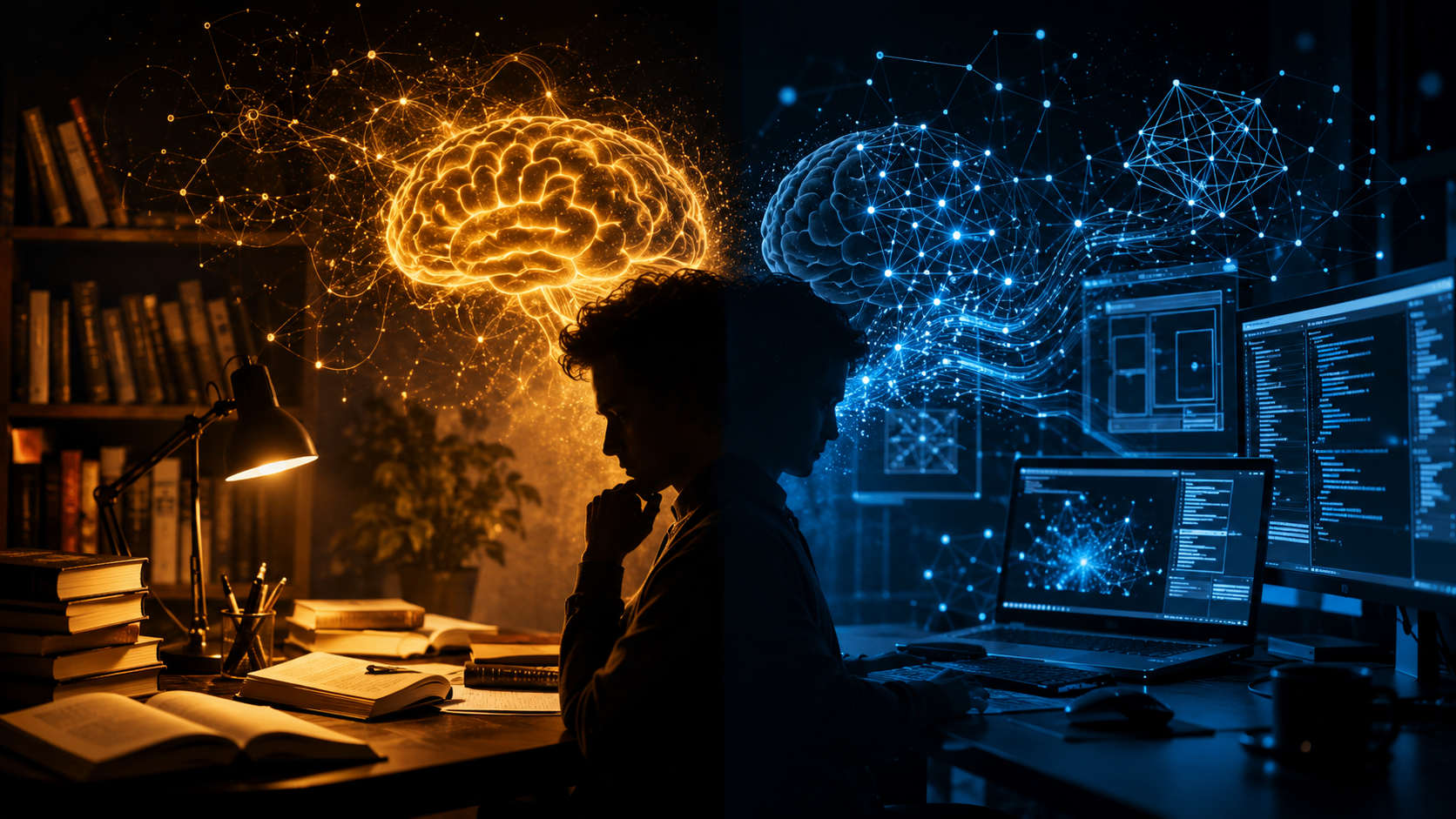
Is AI making us dumb? I have been sitting with this question for a while now, and honestly, the more I think about it, the more I believe the answer is yes, at least for most people. Not because AI is evil or badly designed, but because of how human beings are wired and how unprepared we all are for what just landed on our laps. Workplaces are pushing AI into daily workflows like it is the most natural thing in the world, and barely anyone is asking whether our brains are ready for it.
Let me walk you through how I got to this conclusion, because it did not happen in one thought. It happened through a long conversation where one point kept leading to another, and by the end I was looking at something much bigger than just “AI good or AI bad.”
Is AI Making Us Dumb Because We Stopped Exercising Our Minds?
Here is the logic, and it is pretty simple once you say it out loud. When human beings delegate thinking to computers, they stop exercising their minds. That is it. That is the whole problem in one sentence.
The brain runs on a use it or lose it principle. Anything you stop practicing gets weaker, and anything you keep practicing gets stronger. This is not a new idea, it is basic neuroscience. So when you hand over your writing, your problem solving, your research, and your decision making to an AI, you are not saving time for free. You are trading a muscle for a shortcut.
Cognitive scientists have a name for this, they call it cognitive offloading. Learning and real understanding require what they call cognitive friction. That friction is you struggling through a dense article, wrestling your scattered thoughts into a proper paragraph, or debugging a piece of code line by line until it finally clicks. When AI removes that friction, it also removes the neural strengthening that came from the struggle.
Think about what smartphones already did to our sense of direction. Twenty years ago people built actual mental maps of their cities. They knew shortcuts, they knew which street connected to which. Today if the GPS dies, a huge number of people are completely lost, even five minutes from home. Now imagine applying that same kind of delegation to logic, to synthesis, to creative writing. If we stop practicing how to think clearly, that skill erodes just as fast as our sense of direction did.
So only a small group of people, the ones with what I would call old fashioned habits like sticking to their own ideas, reading real books, and constantly learning new things, are going to keep their edge. Everyone else risks drifting. And here is the harder part. That small group with strong habits belongs mostly to an older generation, the one that grew up before all of this hit. When that generation eventually retires or fades out, who is left holding the standard?
We Have Panicked About This Before, So Is This Time Different?
If you want to play devil’s advocate here, humanity has had this exact panic before, more than once.
Socrates was famously against writing. He argued that once people could write things down, they would stop memorizing them, and their so called wisdom would just be borrowed from a page rather than truly known. He was not entirely wrong, memory did shift from something we carried internally to something we retrieve externally. But deep synthesis, philosophy, science, and literature all flourished anyway.
Then came the pocket calculator. Teachers were terrified that kids would lose the ability to do basic arithmetic in their heads. To some extent that happened, manual computation became less valued. But higher level applied mathematics actually expanded, because people were freed up to think about bigger problems instead of long division.
Then search engines arrived, and we got what researchers call the Google effect, the worry that having instant access to any fact would ruin our memory. And in a way it did shift things. Our memory moved from remembering what the information is to remembering where and how to find it.
The optimistic reading of all this is that AI is not making people dumber in some absolute sense, it is shifting what counts as a valuable human skill. The valuable skill moves from execution, meaning generating the first draft or writing boilerplate code, to discernment, meaning evaluating, refining, and steering what the AI gives you.
That is a fair point. But here is where I think it gets uncomfortable, and where my original instinct about AI making us dumb comes back stronger.
The Real Divide AI Is Creating Between People
AI does not affect everyone the same way. It splits people into two camps, and the gap between them is only going to widen.
On one side you have what I would call the active architects. These are people who understand the underlying domain, who use AI to speed up labor they already know how to do by hand, and who can spot errors or hallucinations because they know what correct actually looks like.
On the other side you have the passive consumers. These are people who accept the first output they get, who skip the foundational learning entirely, and who slowly lose the critical judgment needed to question what they are being handed.
Here is the trap for beginners specifically. An experienced developer can use AI to write code five times faster because they already know when the AI is wrong. A novice who uses AI to skip learning the syntax in the first place may never build the mental models needed to catch a critical mistake. They are building on sand and do not even know it.
This is the power gap in a nutshell. People who already have deep domain knowledge, curiosity, and critical thinking use AI as a massive force multiplier. People who use it as a substitute for learning become dependent on a system they cannot evaluate or challenge. So AI probably will not lower raw human potential across the board, but it will absolutely widen the gap between people who direct the technology and people who are directed by it.
Why “Just Use AI Responsibly” Advice Does Not Work for Most People
There is a whole industry of advice out there telling you how to stay sharp while using AI. Draft your own thoughts first for a few minutes before opening a chat window. Use the AI as a devil’s advocate instead of an answer machine. Never paste AI text directly into your final work without rewriting it in your own words. Keep certain hours of your day completely AI free for strategic thinking.
All of that is genuinely good advice. But here is the problem I kept coming back to. This advice assumes something that is simply not true for most of the world’s population. It assumes people already have the metacognitive tools, the habits of self reflection, the baseline media literacy, and the intellectual discipline needed to intentionally limit their own use of something convenient. That is a huge assumption, and it falls apart the moment you look at how digital technology actually rolled out globally.
Most of the world jumped from basic analogue mobile phones with monophonic ringtones straight to color screens, then straight into the internet, then straight into having a digital shopping cart in their pocket, all within about twenty years. There was no slow ramp up. There was no generation that got a transitional phase to learn digital hygiene, source evaluation, or basic critical thinking about algorithms. People were mostly busy building lives modeled on other people’s lives, chasing ideas of happiness that were themselves manufactured by watching other people appear happy online. And now, on top of all that, suddenly there is AI.
This is what I would call a technological leapfrog without a cognitive bridge. Look at how long previous shifts actually took to settle into society. The printing press took roughly one hundred fifty years to reach mass literacy. The automobile took around forty years before we even had proper infrastructure and traffic laws. Smartphones took about ten years to reach global ubiquity. Generative AI took about eighteen months to become a standard part of workplaces everywhere. There was no transitional runway this time. The technology arrived fully formed, engineered specifically to be as frictionless and as addictive as possible.
There is also a psychological piece here that social theorists call mimetic desire, which is simply wanting something because you saw someone else want it first. Social media feeds were optimized for passive scrolling and constant comparison, rewarding speed over reflection. E commerce eliminated every point of real world friction in buying and searching. And now generative AI is eliminating the very last point of friction that was left, which is thinking itself.
This creates a real knowledge divide. On one side is the institutional legacy, people who were built on deep reading and genuine rigor, who developed real mental models the hard way, and who use AI to augment a foundation that already exists. On the other side is the accelerated present, people whose habits are built on prompt and paste, who never built the foundational mechanics in the first place, and who rely on AI for the primary output rather than a boost. The people currently designing the “use AI responsibly” advice built their thinking skills in an environment where they had no choice but to read books and struggle through problems manually. Newer generations are being handed the shortcut first, before they ever built the foundation the shortcut is supposed to sit on top of. When the generation that built its mental models the slow way eventually retires, the baseline standard for independent thought risks shifting permanently downward, not because people are less capable, but because nobody ever gave them the bridge.
It Is Not Just the Young, Look What Happened to the Boomers
Here is something that gets ignored in almost every conversation about technology and thinking. Everyone assumes this is a story about teenagers and digital natives. But look at what happened to the Baby Boomer generation, many of whom got smartphones and short form video right around retirement age, close to the end of their working lives.
A lot of them suddenly realized, almost overnight, that they had not lived a particularly fulfilling life. And instead of quietly settling into retirement, many changed direction completely. They started investing in themselves again, chasing a youthful look, buying fancier cars, and holding onto their wealth rather than planning to pass it down to their kids.
There is actually a name for this pattern in financial and sociology circles, it is sometimes called SKIing, short for Spending the Kids’ Inheritance, tied to a broader Die With Zero philosophy where people prioritize high end travel, luxury purchases, and personal experience over leaving anything behind. Short form video algorithms fed retirees an endless stream of idealized “youthful aging” content, and it created a widespread realization that slowing down was optional, which pushed many toward cosmetic procedures, aggressive fitness routines, and constant personal reinvention.
This has real consequences on families. Relationships have strained because parents who are technically retired are still living like they are in their thirties, right around the time their own adult children are finally ready to get married or have kids. Instead of stepping into a grandparent role focused on family, many of these older adults are living out a kind of second youth focused on their own hobbies, travel, and dating. The timeline has stretched out everywhere. People marry later, they become grandparents later, and the average age of major life milestones keeps climbing.
Why did this hit so suddenly and so hard for this particular generation? Younger people grew up inside algorithmic feeds and built up a kind of built in skepticism or fatigue toward them over time. Older adults encountered these same feeds after their worldview was already fully formed, and the endless stream of comparison forced a sudden and jarring question onto millions of them, something like did I spend my whole life working just to sit quietly in a rocking chair, or should I go live for myself before it is too late.
The broader pattern here is simple and a little humbling. Human beings of any age are vulnerable to technology stripping away friction. Handing an algorithm engineered to exploit desire and fear of missing out to people confronting their own mortality does not produce quiet reflection, it produces a sudden self focused pivot. Wisdom is not guaranteed by age. Without intentional distance from the technology, it reshapes behavior at eighteen just as easily as it does at sixty eight.
Why Slowing Down to Think Is a Luxury Most Young People Cannot Afford
Here is where I think the conversation gets the most real, and honestly the most frustrating. My genuine belief is that AI will make things worse specifically because Boomers are still going to be around and in control of most of the world’s resources for another twenty years or so.
Yes, a handful of young people are innovating and building impressive things. But the vast majority of young people around the world are living a genuinely brutal life, many of them in extreme poverty, facing job markets with brutal competition, no easy access to loans, no housing security, and no real healthcare safety net. For them, AI is not a philosophical debate about cognitive friction, it is a shortcut out of a tough day. It gives them the illusion of speed. I wrote this code in a fraction of the time it used to take. I can vibe code an entire app or website now. I wrote this email or letter in under five seconds. I designed this graphic using ChatGPT or Gemini in a couple of minutes. That is the appeal, and it is a completely rational one given their circumstances.
Telling someone working three jobs, or facing an unpayable rent increase, to slow down and embrace cognitive friction is completely detached from the world they actually live in. When survival is your daily baseline, speed becomes the only currency you have left. This cognitive hurry is not laziness, it is an economic response to a genuinely unfair set of conditions. Vibe coding an app in a weekend or generating a campaign strategy in five minutes feels like real leverage when you are trying to break through the noise in a hustle economy. If taking three weeks to properly write clean code or do original research means missing rent, people will take the shortcut every single time, and honestly, who could blame them.
There is something researchers call the illusion of competence at play here too. You produce a polished output in seconds, so your brain quietly tells you that you made it yourself. But because the actual labor was outsourced, no lasting mental model ever gets built. You feel capable without becoming capable.
Underneath all of this is a much bigger structural issue, which is wealth concentration and an ownership lockout. When real estate, capital, and corporate equity are locked up by an older generation, younger people are not building any foundational security, they are essentially renting their entire existence month to month. Deep thinking and real innovation have always required a safety margin, some financial buffer that lets a person fail, experiment, and reflect without immediately facing eviction or crushing debt. When that margin disappears, deep thinking stops being a habit and becomes an unaffordable luxury.
Even the corporate world is rewarding this shift. What the market used to reward was deep domain mastery and original synthesis and long term architecture. What the AI powered workplace rewards now is assembly speed, derivative consensus, and rapid disposable prototyping. Companies demand volume and speed above everything else, and workers who try to maintain real depth get penalized for being slow. The system itself is incentivizing cognitive offloading at scale.
So here is the trap in three steps. Economic pressure forces younger generations into a constant cognitive hurry. AI offers exactly the illusion of speed needed to survive that hurry. And by relying on that shortcut just to get by, people gradually lose the deep foundational knowledge they would actually need to challenge the systems, landlords, and platforms controlling them in the first place. It becomes a closed loop where the very tool people use to try to get ahead in a rigged game keeps them permanently dependent on infrastructure owned by the same elite they are trying to outrun.
So Where Do We Go From Here
Given everything above, is AI making us dumb a lost cause? I do not think so, but the fix is not individual willpower, it has to be collective.
The most important thing young people can do right now is build together, at a grassroots level, mirroring the kind of organization the elite already have at the top. Brainstorming groups, mastermind circles, peer learning collectives, as many as possible. The goal is a future that actually fits their needs instead of one designed around dependence on big tech, big pharma, and big finance. There are already real examples of small groups of young people using nothing but their own talent to build startups that create genuine waves in otherwise steady waters.
This is not just wishful thinking, it is historically exactly how societies have survived periods of extreme consolidation and institutional failure. When centralized systems become too extractive, the only real defense has always been decentralized, localized solidarity built from the ground up. Political theorists call these parallel structures or counter power. When the mainstream economy stops offering a path to ownership, stability, or dignity, you do not fight the giant on its own terms, you build an alternative system that runs alongside it.
We are already seeing early seeds of this. Platform cooperativism is one example, where developers and gig workers form worker owned digital platforms instead of handing thirty percent of everything to a venture backed company. Local masterminds and informal peer to peer learning circles are filling the gap in regions where formal education is either out of reach or badly outdated.
The same logic applies to decoupling from the big three. In technology, that means open source software, local data cooperatives, and decentralized protocols that do not depend on centralized servers. In finance, that means community land trusts, micro lending circles, and cooperative credit networks that keep capital inside the local community instead of flowing upward. In health and food, that means community supported agriculture, localized care networks, and preventive community health collectives instead of relying entirely on industrial supply chains and reactive medicine.
There is one more piece that matters more than people realize, and that is becoming more human. When AI makes raw digital execution cheap and instant, it simultaneously makes real human traits expensive and valuable. You cannot algorithmically fake genuine trust. Local networks built on personal accountability and face to face relationships create resilience that no corporate entity can easily disrupt. When people build together as co owners rather than as employer and employee, their incentives align around long term survival instead of quarterly extraction. A group of ten people deep skilling together, checking each other’s ideas, and sharing open tools will consistently out think a single isolated person passively typing prompts into a chat window.
The younger generation does not need to out compete the elite at their own game, the capital gap is simply too wide for that to work. The real strategy is disengagement and alternative construction. Form the localized, high trust mastermind groups. Share knowledge openly instead of hoarding it. Build small cooperative micro economies. That is not just surviving the brutal future that is coming, it is quietly building the blueprint for whatever comes after it.
Final Thoughts on Whether AI Is Making Us Dumb
So is AI making us dumb? I would say the honest answer is not exactly, but it is exposing something that was already fragile. AI itself is not the villain here. It is a mirror held up to how unprepared, unequal, and economically squeezed most people already were before it showed up. The people who already had strong thinking habits, financial breathing room, and time to reflect will use AI as a genuine force multiplier. Everyone else risks sliding into a dependence they never consciously chose, not because they are careless, but because nobody ever gave them the bridge to cross safely.
The real answer is not to fight AI or to pretend the danger is not real. It is to build the kind of human connection, shared knowledge, and collective ownership that no algorithm can replace. That is how we make sure the answer to is AI making us dumb stays a warning we took seriously, rather than a description of what actually happened to us.
Frequently Asked Questions
Is AI actually making people dumber? Not in a fixed or permanent sense, but relying on AI without building your own foundational knowledge first can weaken skills like memory, synthesis, and critical thinking over time, the same way any unused muscle weakens.
What is cognitive offloading? Cognitive offloading is the habit of handing mental tasks like memory, calculation, or writing over to an external tool instead of doing them yourself. It saves effort in the moment but reduces the mental practice that builds long term thinking skills.
Can AI make people smarter instead of dumber? Yes, for people who already have strong domain knowledge and critical thinking skills, AI acts as a force multiplier rather than a replacement for thinking. The outcome depends heavily on whether someone uses AI to skip learning or to speed up work they already understand.