The man next to me leaned over and asked, in broken English, if he could use the power outlet at my station.
I replied in Spanish:
“Claro que sí, úsala sin problema.”
His eyebrows jumped. A pause. Then came the line I’ve heard in different forms a hundred times:
“I saw your face and thought you were not Spanish… so you might not speak Spanish.”
He meant well. Maybe. But this wasn’t about language. It was about the face.
Mine.
Brown. Bearded. Not “Spanish enough,” apparently.
And the strange part? That day, more than 40% of the people in that co-working space in Zaragoza were brown — Chilean, Mexican, Indian, Ecuadorian.
The faces were many. The assumptions? Still singular.
Semana Santa and the Silence of Power
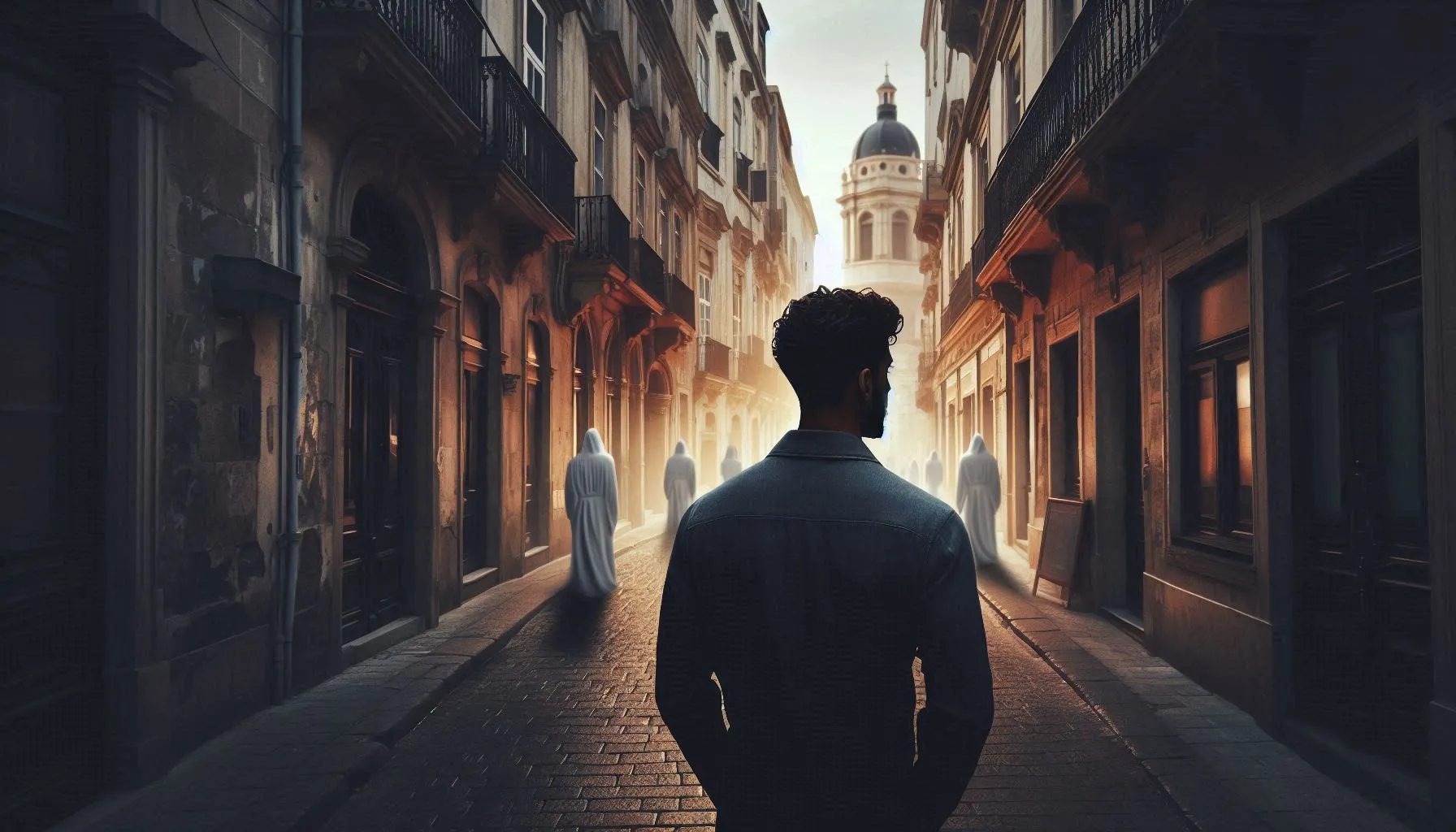
A few days later, I walked through Zaragoza’s old town during Semana Santa.
Men in hooded robes with pointed caps moved silently through cobblestone streets. Candles flickered. Tourists snapped photos. Locals wept.
But all I could see were white-robed figures with pointed hoods.
It looked disturbingly like the Ku Klux Klan.
And here’s the twist: the KKK didn’t invent that look. They borrowed it — from Spain.
The Capirote: A Hood for Control, Not Humility
The pointed hood, or capirote, wasn’t always a religious symbol.
It began as part of the sambenito — a humiliating costume used during the Spanish Inquisition to mark and punish “heretics”:
- Jews
- Muslims
- Conversos
- Free thinkers
According to scholars at the University of Seville, these garments weren’t signs of penance. They were instruments of public shame and domination.
People were tortured, forced to convert, or executed. It wasn’t repentance. It was control — a confession worn on the body.
So when I see these hooded processions today, I don’t see humility. I see dominance, dressed up as tradition.
Because if your face is covered, who exactly are you repenting to? If it’s between you and God, why march through the streets?
Colón and da Gama: Heroes on Paper, Monsters in Reality
In Spain, Cristóbal Colón and Vasco da Gama are still celebrated as explorers. Children learn of their “discoveries.” Streets bear their names.
But according to documents in the Archive of the Indies:
- Colón enslaved, raped, and decimated indigenous populations in the Caribbean within a few short years.
- Da Gama burned entire ships off the coast of India — civilians, women, children, all turned to ash.
Their brutality rivals modern war criminals.
And yet, their statues stand. Because here, history isn’t just written by the victors. It’s performed by them—again and again—in monuments, holidays, and schoolbooks.
When Black Means Evil and White Means Divine
In churches across Spain, demons are painted black. Angels are white, blond, and glowing.
The Moors — who once ruled this land, built cities, preserved science, and nurtured coexistence — have been reimagined as dark-skinned threats.
A 2019 study by the University of Granada found that over 80% of religious art in Spanish churches depicts evil with dark skin and goodness with pale features.
To this day, being brown in Spain often means being the uninvited guest in a palace your ancestors once built.
Shared Memory, Not Shared Guilt
This piece isn’t about guilt. It’s about memory.
According to Spain’s Commission for Historical Memory, fewer than 30% of students are ever taught the darker truths of Spain’s colonial and inquisitorial past.
That silence becomes part of the story. Because if we don’t speak about it, the assumptions—hidden in ritual, art, and polite smiles—just keep marching on.
Look Again. Speak Up. Unmask the Story.
Next time you see a hooded figure in Semana Santa… Or hear someone call conquistadors “explorers”… Or feel someone question your presence because of your skin…
Ask yourself:
What story am I being told? And who was forced to stay silent when it was written?
The most powerful gift we can give history isn’t reverence. It’s honesty.